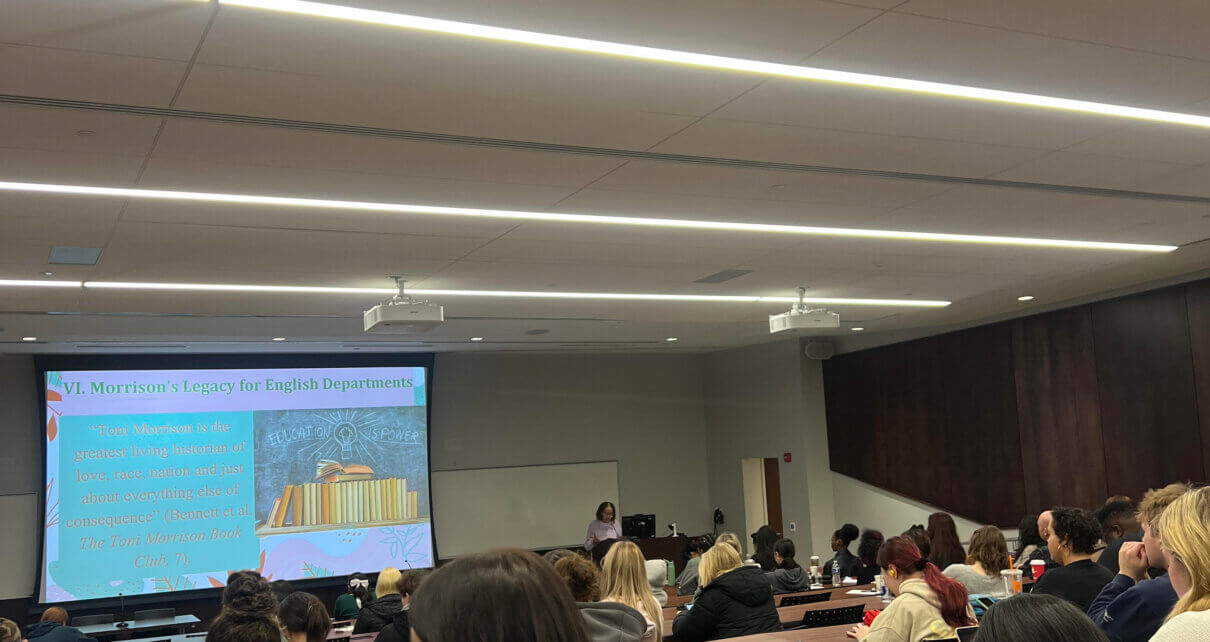
Students and faculty gathered in Pozycki 115 at 10:05 a.m. to kick off the 7th Annual Toni Morrison Day on Feb. 20, hosted by the English Department. This year’s theme was “A Legacy Across Generations.”
Toni Morrison was an American novelist and editor who was awarded the Nobel Prize in Literature in 1993. Morrison became the first Black American to win the Nobel Prize in Literature.
The day-long event consisted of panels, discussions, contests, and ended with an open mic session from 3:15-4:00 p.m.
The English department welcomed Piper Kendrix Williams, PhD, to deliver the keynote address. Williams is a professor of English and African-American Studies at The College of New Jersey, as well as the Chair of the Department of African-American Studies and co-author of the Toni Morrison Book Club.
David Golland, PhD, and Dean of the School of Humanities and Social Sciences gave the opening remarks, followed by the chair’s address by Associate Professor and Department Chair, J.P. Hanly, PhD. Golland said this year’s theme, “Invites us to ask what does it mean for a writer’s legacy to stretch across generations?”
Golland explained that Morrison’s novels are not reliques of the past but part of our present, that students who read them today can relate while faculty discover new aspects each time.
Aidan Cole, a senior music industry major, who attended the keynote address said after reading Morrison’s novel “Beloved” last semester for a class, he related to the trauma discussed in the book. He was intrigued by Morrison’s writing and style, which ultimately led him to attend Toni Morrison Day.
Hanly explained how Toni Morrison Day came to be at Monmouth and why, thanking the English department’s previous chair, Dr. Susan Goulding for the foresight to purpose an annual Toni Morrison Day. Goulding felt led to organize something in Morrison’s memory after her passing in August 2019. Hanly added he has come to recognize that Goulding as well as the department felt led to establish this day because Morrison’s work, thought, writing, and legacy are uniquely generative. “Morrison’s work challenges us to examine our assumptions, to think about the social, ethical and historical implications of how we use language,” he said.
Goulding shared her experience with Morrison’s work, explaining that as an undergraduate and graduate student she never had coursework that engaged with Morrison’s work. She would read her work on her own with the influence of her mother, Lucille Goulding, who was an education advocate, avid reader, and founder of the Head Start program in our district. “Her works have given me the privilege of a window into the experiences of American history through a lens not available to me from my own background. Reading them has allowed me to see inexplicable pain and suffering, as well as resilience and survival in its truest form, and to understand the importance of language as well. I hope the same holds true for our students as we try to share Morrison’s legacy not only through Toni Morrison Day but in our curriculum,” Goulding said.
In William’s address she said, As we gather during Black History Month, a time to honor the struggles, triumphs, and stories of Black Americans, it feels particularly meaningful to discuss the legacy of Toni Morrison.” She continued, “Her writing reminds us of the power of memory, identity, and the stories we tell about ourselves and each other. Being here with you, sharing ideas and reflections, is exactly the kind of reminder I need of why this work matters.”
Williams said that before Morrison ever became the first Black woman to win the Nobel Prize, she had already reorganized the imaginative center of American literature. “She placed black people at the center. Not as the problem, not as the metaphor, not as an allegory for national guilt. But as a fully realized, living human being,” Williams said.
Williams dove into Morrison’s literature, discussing the characters, the meaning, the inheritance, and the power behind her language through seasons and cycles. “For me, Toni Morrison’s legacy across generations insists that we understand ourselves as living inside cycles of history, of memory, of harm, and repair.”
With power comes challenges. “Literacy was not neutral. It was insurgent,” Williams said. Williams explained in Morrison’s grandfather’s lifetime it was illegal for him to read. It was illegal for white people to teach Black people how to read.
Taught by her sister to read, Morrison was defying a system. Words to her as Williams explained were tools, they were sustenance, they were a defense.
“They [Morrison’s novels] refuse to deposit simplified narratives. They demand engagement. They require the reader to assemble meaning, to navigate shifting perspectives, to hold contradiction,” Williams said.
When text like Morrison’s is brought into the classroom, Williams said it’s not just being analyzed as literature, but a way of thinking that resists simplification is being modeled. “To teach her is to ask students to slow down, to sit with ambiguity, to notice silence.”
Cole said when asked what he took away from the address, “I think there can be comfort in ambiguity, that there can be comfort in contradiction, you don’t need to shy away from it or simplify it.”
Morrison’s novels continue to get banned in districts and libraries. Williams explained that what she has learned through the banning of a book in her own area is that a lot of people hear what they think the book is about instead of reading it for themselves, and ban it based on what they hear.
Williams tells her students some of the things Morrison writes about might make them feel discomfort but to practice the pedagogy of discomfort because you’ve never grown without discomfort.
When asked what Williams hopes the students take away from the address she said, “When they read, don’t treat the language like it’s dead. And then, when they read, see themselves in the book.”
With that, Williams opened the floor to questions and proceeded to sign copies of the “Tony Morrison Book Club” outside Pozycki 115.
Branden Van Allen, the event’s student worker said, “Seeing our Professors and administrators behind the scenes and seeing how much pride and genuine excitement they have behind it means a lot.”
Golland said it perfectly, “Legacy is not passive, it requires cultivation. To honor Toni Morrison across generations, we must do more than assign her texts. We must create space for dialogue, we must protect intellectual freedom, we must encourage difficult conversations rather than retreat from them. We must invest in young readers and writers just as she did.”