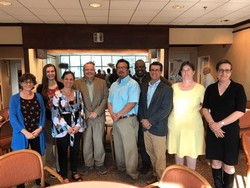
Students, faculty and local community members gathered on Thursday, Mar. 27 at Monmouth University for a symposium examining the historical impact of Native American boarding schools, featuring a keynote speech by historian, Brenda J. Child.
The event was held at 10:05 a.m. in the Great Hall Auditorium, focusing on the theme “Boarding Schools and American Indian Dispossession.” The event also featured a Native American boarding school exhibit in the basement of the Great Hall and a display in the library hall, which included a book collection. Food and refreshments were available throughout the event.
Child, a Northrop Professor of American Studies at the University of Minnesota and a citizen of the Red Lake Ojibwe Nation, opened her remarks by underlining the importance of having continuing conversations around Native American history. “It’s important to remember this history,” she said. “Even though I’ve been thinking about this for decades . . . there are other people like our students who are learning about it for the first time.”
Her research uncovered the origins and development of federal boarding school policies, referencing institutions such as the Carlisle Indian Industrial School, the Flandreau Indian School and the Haskell Institute. These schools, she explained, were part of a broader federal system designed to relocate Native communities.
Child emphasized how Native families often had to make difficult and complex decisions about sending their children to these institutions. “I always see that first generation of boarding school student . . . having a lot to do with basic survival,” she said. “They wanted their children to live.”
She also described how experiences differed across generations, pointing to the 1930s as a key turning point. During the Great Depression, enrollment in boarding schools such as Flandreau and Haskell considerably increased. “Families in the 1930s were making decisions based on the best interests of their family life or their children,” she said. Child went on to add that “the problems that Native people were having in the 1930s during the Great Depression were not the same problems that people were having when the Carlisle School opened in 1879.”
The theme of the symposium further examined the daily realities of boarding school life, including both discipline and resistance. Child described how students pushed back against strict institutional control. “Boarding school students could be very rebellious,” she said. “There were children who burned down boarding schools . . . there were children who cut the electricity . . . went into the kitchen, pillaged all the food.”
Health conditions within these institutions were also a major focus of her remarks. Child discussed how diseases such as tuberculosis and influenza spread within boarding schools, often with limited understanding of how they were transmitted. She cited letters between families and school officials that revealed widespread concern. “There were constant requests from families to have their children see doctors,” she said.
She noted that many boarding schools, including Flandreau, maintained on-site hospitals, yet illness and death remained a persistent issue. These conditions, she explained, contributed to the emotional burden on both students and their families.
Throughout her insightful lecture, Child incorporated personal and important relics, including letters written by her own relatives who attended boarding schools. These artifacts exhibited everyday concerns such as bringing children home for visits and maintaining family connections despite long separations.
Child also discovered the cultural aspects of boarding school life, including athletics and extracurricular activities. She referenced the Carlisle Indian Industrial School’s athletic programs, which included notable figures such as Jim Thorpe, and shared that her great-grandfather played football with him.
Despite these contrasted experiences, Child stressed that boarding schools must be understood within a wider federal design. Although assimilation is sometimes viewed as the central goal, she argued that it does not fully depict the intent behind these institutions. “Assimilation . . . was a smokescreen,” she said. “It wasn’t what boarding schools were about.”
As an alternative, she illustrated land dispossession as the key objective of federal policy. “It was about dispossessing Indian people of their land,” Child said, explaining that boarding schools operated alongside federal policies such as allotment to assist in extensive land loss.
She added that by the 1930s, much of this dispossession had already occurred, leading to a shift away from the boarding school system. “The big dispossession of Native people . . . had already taken place,” she said. She continued by saying that this marked a transition toward public education for Native students.
Child concluded her impactful discourse by underscoring the persistent effect of this tragic era.
“The boarding school era is a story of Native dispossession,” said Child.