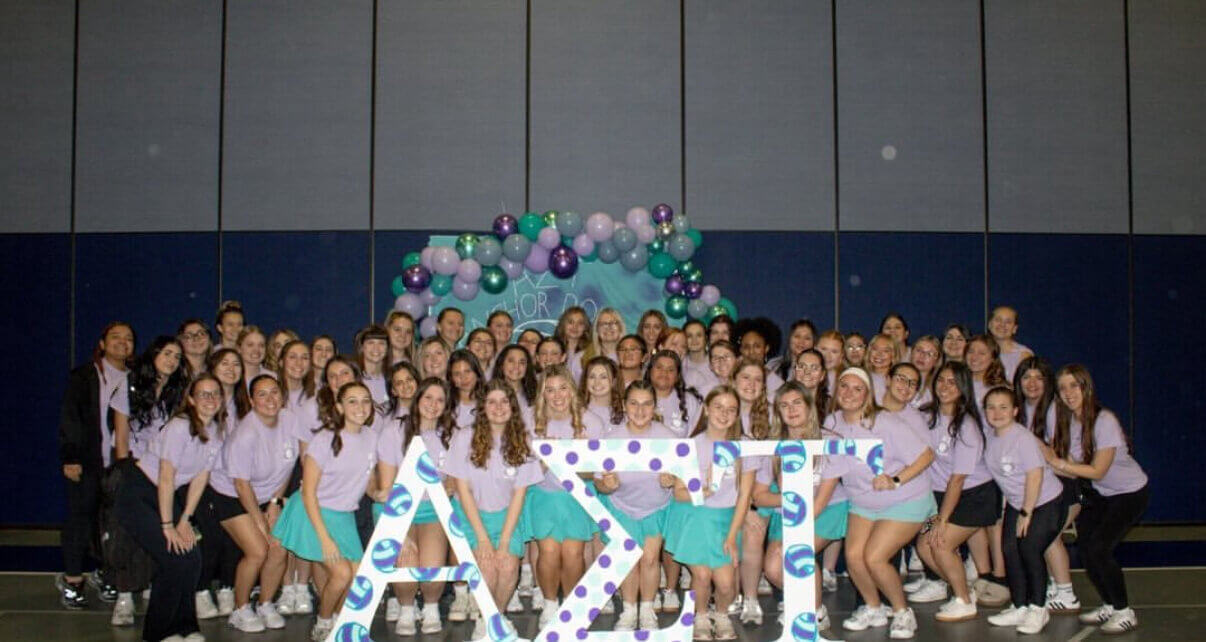
Alpha Sigma Tau Beta Omega Chapter hosted its annual Anchor Bowl volleyball tournament on Nov. 14 at Boylan Gym, raising over $1,500 and raising awareness for 180 Turning Lives Around, a local nonprofit that supports survivors of domestic violence and sexual assault.
The tournament brought together organizations across campus, drawing sororities, fraternities, club teams, and non-greek students for a night of competition aimed at community engagement and philanthropic impact.
AST’s Director of the Women’s Wellness Initiative, Isabella Lemke, said the shift from last year’s Anchorman-style themed event to a fully athletic competition was intentional, designed to include more students and create a more energetic fundraiser.
“Last year, the feedback we got was that the event wasn’t as engaging because only a few people participated,” Lemke said. “This year, I wanted to take a different approach that included every organization, whether greek or not. Everyone’s played volleyball in gym class, so it’s something anybody can jump into.”
Lemke said the planning process began over the summer, after she connected with the Director of Philanthropy at West Chester University, where a similar event had been held. With guidance from athletics, fraternity and sorority life, an internal committee, and help from Monmouth’s men’s club volleyball team, preparations ran smoothly leading up to the tournament.
The new format attracted a wide range of participants who filled the gym for several hours of bracket-style play. Lemke said she hoped the event would leave students with a shared sense of purpose and community. “I want the players to remember that we are a community at Monmouth coming together to have fun for a good cause,” she said. “And because we’re raising money for a local nonprofit, it really connects us to something bigger.”
180 Turning Lives Around, based in Hazlet, provides confidential resources and support for survivors of domestic violence, sexual assault, and human trafficking.
Sophiana Avedis, a representative from 180 who attended the event, said the organization is deeply appreciative of Monmouth students’ involvement.
“It just means so much to know that the local college community is interested in these issues and supportive,” Avedis said. “Domestic violence and sexual assault are really prevalent and can happen to anyone at any age. We hope students learn that there are resources available and that they’re never alone.”
The event also gave fraternity and sorority life an opportunity to highlight the role service plays in building campus culture.
Associate Director of Student Engagement for fraternity and sorority life, Jayde Ware, said AST’s new format shows how chapters can expand participation by experimenting with different approaches.
“I love seeing a team sport where people get so invested,” Ware said. “You can get more people involved, and it brings a different energy than a single-person competition. For fraternities and sororities, so many of our organizations were founded to help better the community. An event like this lets students connect socially while also supporting a cause that’s doing real work locally.”
Ware added that philanthropy events often show greek life at its best. “People might see the tabling or the social aspects, but events like this show the whole community coming together to raise money for something meaningful,” she said.
For many players, the tournament was meaningful both for its purpose and its atmosphere.
Matthew Sejack, a brother of Sigma Pi, said he learned about 180 Turning Lives Around through the event and quickly understood the importance of supporting it.
“To be completely honest, I had no prior knowledge about 180 Turning Lives Around until I participated in this event,” Sejack said. “I learned all about the cause and how important it is to people struggling with domestic violence and sexual assault.”
He added that campus philanthropy helps students recognize issues they might not otherwise think about. “Without these smaller events, many people would be unaware of real-world problems that need support,” Sejack said. “These events make a huge impact on the causes they support.”
Sejack also reflected on what it meant to compete alongside his fraternity brothers.
“Participating in the Anchor Bowl was amazing,” he said. “I was able to play the sport I love while helping spread the organization’s message. And being able to win the event with my brothers of Sigma Pi and show our support made it even better.”
For Lemke, that sense of unity is exactly what she hopes students take away from the night.
“We’re here to have fun as a campus,” she said, “but also to support survivors, raise awareness, and make sure people know that resources exist. If students leave knowing that and feeling connected, then the event did exactly what it was meant to do.”