“Whatever our souls are made of, his and mine are the same,” describes the fiery passion between Catherine, “Cathy,” Earnshaw and Heathcliff in the film “Wuthering Heights.” Based on the 1847 novel by Emily Brontë, the adaptation, directed by Emerald Fennell, has divided viewers and critics.
Released on Feb. 13, “Wuthering Heights” follows Cathy, played by Margot Robbie, and Heathcliff, played by Jacob Elordi, as the two grow up together and eventually fall in love. However, when Cathy is proposed to by wealthy neighbor Edgar Linton, played by Shazad Latif, she accepts, knowing she cannot survive in her poverty and cannot be with Heathcliff for that reason. Upon this, he leaves, returning a couple years later dripping with wealth. Heathcliff’s arrival sparks a passionate, intense affair between himself and Cathy that is doomed from the start and ends in tragedy.
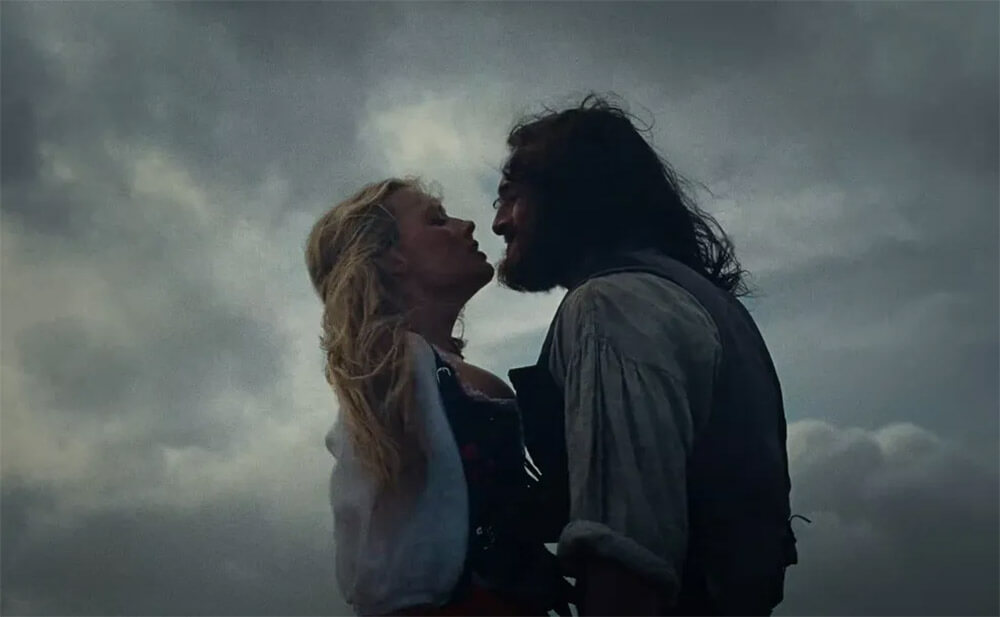
Visually, the film is stunning. Filmed in Yorkshire, the foggy, dark, broody landscape adds to the feeling of imminent doom as well as an air of suspense. Will Heathcliff and Cathy get caught by her husband, Edgar? The Linton family house, Thrushcross Grange, is a modern take on a late 17th century home, displaying the wealth and luxury of its owners. Pops of red and pink are found throughout the estate, driving home themes of love and passion. The costumes (although not historically accurate) are stunning and add emphasis to the fact that this is an adapted version of the novel. They also create the idea that Cathy and Heathcliff’s love transcends time. The two will always find a way back to one another, no matter the circumstances and cannot live without one another.
Another notable element is the soundtrack to the film which features Charli XCX. Her album, “Wuthering Heights,” released Feb. 13 at midnight. Her songs continue to add layers of emotion to the story. Notably the lead single, “Chains of Love” is used after Cathy marries Edgar and feels trapped. Lyrics such as, “My face is turning blue/Can’t breathe without you here/The chains of love are cruel/I shouldn’t feel like a prisoner,” highlight her need to be with Heathcliff.
Fennell has continuously stated this is her take on the classic novel, hence the quotes around the title on the movie poster. She did not create “Wuthering Heights,” this is her reimagining of it. Fennell stated, “The thing for me is that you can’t adapt a book as dense and complicated and difficult as this book. I can’t say I’m making ‘Wuthering Heights.’ It’s not possible. What I can say is I’m making a version of it.” Her version is different from the novel in its erotic, overly sensual behavior that can be traced back to her previous film “Saltburn.” Upon its release in Nov. of 2023, audiences were shocked by the presence of such grotesque, taboo scenes.
It’s clear Fennell wanted to channel that same shock, but to a lighter degree with “Wuthering Heights.” Many times Cathy and Heathcliff are outside, drenched from rain, having a tense, heated moment. These scenes are drawing some backlash, though with critics noting a lack of substance in the film. At times, the plot can feel stagnant, instead of moving forwards the audience is forced to stay with the characters as they are, consumed by their emotions. The characters are also deeply flawed and often cruel at times. There are no true heroes in the story and there is no one to root for. Yes, audiences ultimately want Cathy and Heathcliff to end up together, but it can feel difficult at times when they are manipulating and taking advantage of everyone around them.
“Wuthering Heights” is also receiving criticism for the casting of Elordi as Heathcliff. In the novel, Heathcliff is described as a “dark-skinned gypsy,” with black hair and dark eyes, while Elordi is a caucasian actor. Fans of the novel have accused Fennell of whitewashing the character, thus doing away with the theme of race in the novel. An integral part of Heathcliff’s character in the novel was how he felt like an outsider due to his racial identity.
It seems to be a toss of the dice in whether audiences will love or hate the movie. If viewers can separate Brontë’s novel from Fennell’s adaptation and allow them to be two different entities, the film might be enjoyable. Her hope seems to be that people will consider the film its own story, “There’s a version that I remembered reading that isn’t quite real. And there’s a version where I wanted stuff to happen that never happened. And so it is ‘Wuthering Heights,’ and it isn’t.”