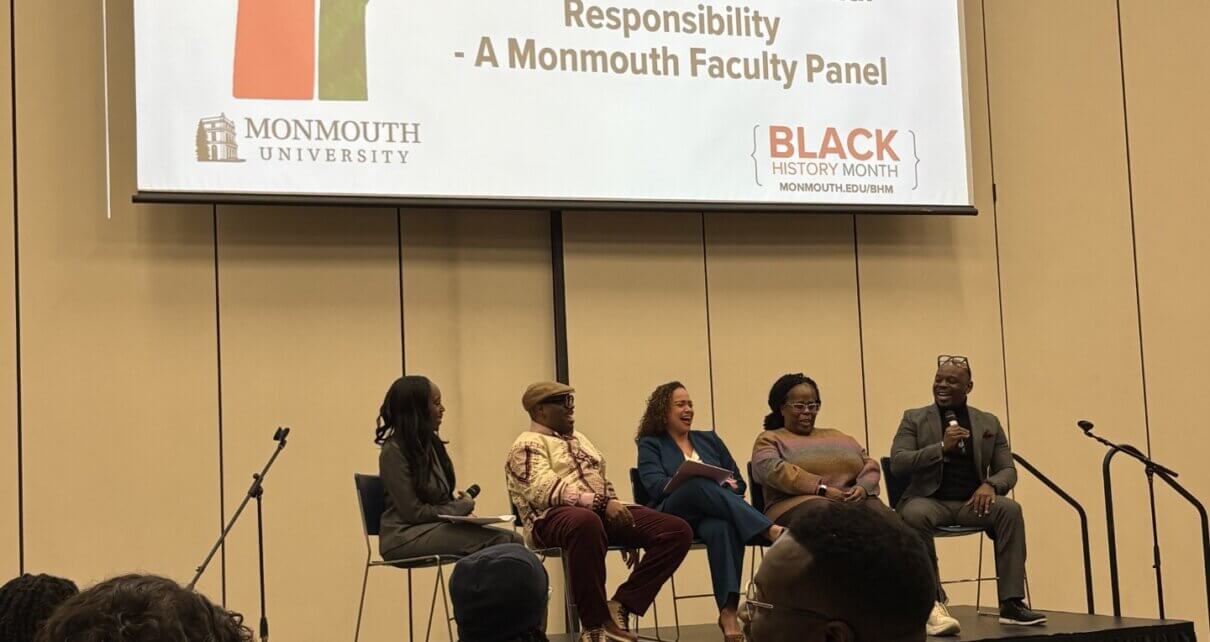
For many college students, and even faculty members, the feeling of not belonging is considered to be a constant struggle—it’s mainly hidden and often internalized. It can appear when you walk into a classroom and realize you are one of only a few who look like you, or when your accomplishments feel overlooked by peers despite the relentless and tireless work you put in.
Those subjects were at the center of Standing in Our Shine: Reframing “Imposter Syndrome” as Institutional Responsibility, a Black History Month faculty panel held Wednesday, Feb. 4, in Anacon A of the student center at Monmouth University. Organized and moderated by Olivia Smith, an undergraduate communication major and Marketing and Public Relations, Chair for the Black Student Union, the event brought together many students, faculty, and staff for an honest and straightforward conversation about belonging, representation, and accountability in higher education.
Rather than framing “imposter syndrome” as an individual insecurity, the panel emphasized that these feelings are often deep-rooted in institutional structures—particularly within predominantly white spaces—that fail to support, recognize, and protect Black and Brown students and faculty.
The panel featured Hettie V. Williams, Ph.D., Associate Professor of History and Anthropology; Nicole Pulliam, Ph.D., Associate Professor of Educational Counseling and Leadership; and David Ford, Ph.D., Associate Professor of Professional Mental Health Counseling. Smith was joined as a co-moderator by Lewis F. Thomas III, Ed.D., Assistant Professor of Educational Leadership and the Ed.D. Program.
Pulliam, a first-generation college graduate, shared how the idea of imposter syndrome followed her throughout her academic career—until she began to question the term itself.
“For a long time, that imposter narrative carried me,” Pulliam said. “But I started to realize we were not, in fact, imposters. There are Black and Brown folks doing incredible things who simply are not being acknowledged for them.”
Pulliam explained that the original research behind the concept never accounted for race or systemic exclusion. In her own scholarship, she later connected with one of the original researchers, who asked her not to refer to it as a “syndrome.”
“The problem with that word is that it places blame on the individual,” Pulliam said. “When we hear ‘syndrome,’ we assume something is wrong with us. But belonging is not just a feeling. Belonging is a structure.”
That characteristic became one of the panel’s most emphasized points. Pulliam stressed that students and faculty often internalize exclusion as personal failure, when in reality, institutions are responsible for the systems that shape those experiences.
“College campuses are microcosms of society,” Pulliam said. “We walk into spaces already bracing ourselves, looking for reasons, we don’t belong. That’s a trauma response.” She stressed the importance of community and self-affirmation. “Find your people—people who see you, who remind you of your worth when you forget it.”
Williams focused her remarks on mentorship and access, emphasizing how critical guidance can be for students navigating academic spaces. “One of my favorite topics is mentoring,” Williams said. “I had so many great mentors in my life, and they didn’t always look like me or come from my department.”
Williams continued by authentically encouraging students to seek out mentors who value and support them—no matter the academic criteria—and to build a small, trusted network. “You may need different mentors for different parts of your life,” she said. “A writing mentor, a research mentor, a teaching mentor. Don’t limit yourself to one person or one space.”
Ford expanded on these principles by addressing how academic environments can wear people down when they feel constant pressure to prove themselves. As a first-generation college student, he also stressed that institutions must support their diversity commitments with real protection and meaningful policy change. “We can’t say we value diversity without putting power behind those words,” Ford said. “Students and faculty notice when institutions don’t follow through.”
Ford also communicated to students about prioritizing well-being and authenticity. “I don’t want you to ever get into a space where you have to fight so hard to be yourself that your health suffers,” he said. “Your success should not require that kind of sacrifice.”
Thomas conveyed a historical and personal lens to the discussion, connecting present-day academic experiences to generational trauma and resilience. He shared his family’s history and explained why reframing imposter syndrome matters beyond communication.
“This conversation is not just about a term,” Thomas said. “It’s about how racism gets renamed, repackaged, and passed down—and how institutions continue to benefit from it.”
Thomas also reminded students of their influence within university spaces. “All of us on this stage are here because of the students who attend the University,” he said. +“You have power, whether you realize it or not, to push institutions to be better.”
Throughout the discussion, Smith steered the conversation with purposeful questions dedicated to practical changes, and how universities can create environments where students feel represented, supported, and protected. Each professor pointed to satisfactory changes such as hiring practices, inclusive programs, leadership accountability, and institutional advocacy as essential steps forward.
“We can’t just tell students they belong,” Pulliam said. “We have to show it—through who we hire, who we promote, whose voices are centered, and who is protected.”
After the discussion, Smith opened the floor to audience questions, inviting students and faculty to engage directly with the panel. The conversation extended beyond the panel itself, with dinner and snacks provided and attendees continuing conversations casually.
As the evening transitioned into conversation among attendees, the message of Standing in Our Shine remained loud and clear: feelings of exclusion don’t happen on their own, institutions need to be held accountable and to reflect on how they contribute to old societal norms.