Sept. 11, 2026 marked 25 years since al-Qaeda carried out a terrorist attack hijacking four planes that were crashed into the World Trade Center, the Pentagon, and a field in Shanksville Pennsylvania, killing a total of 2,977 people.
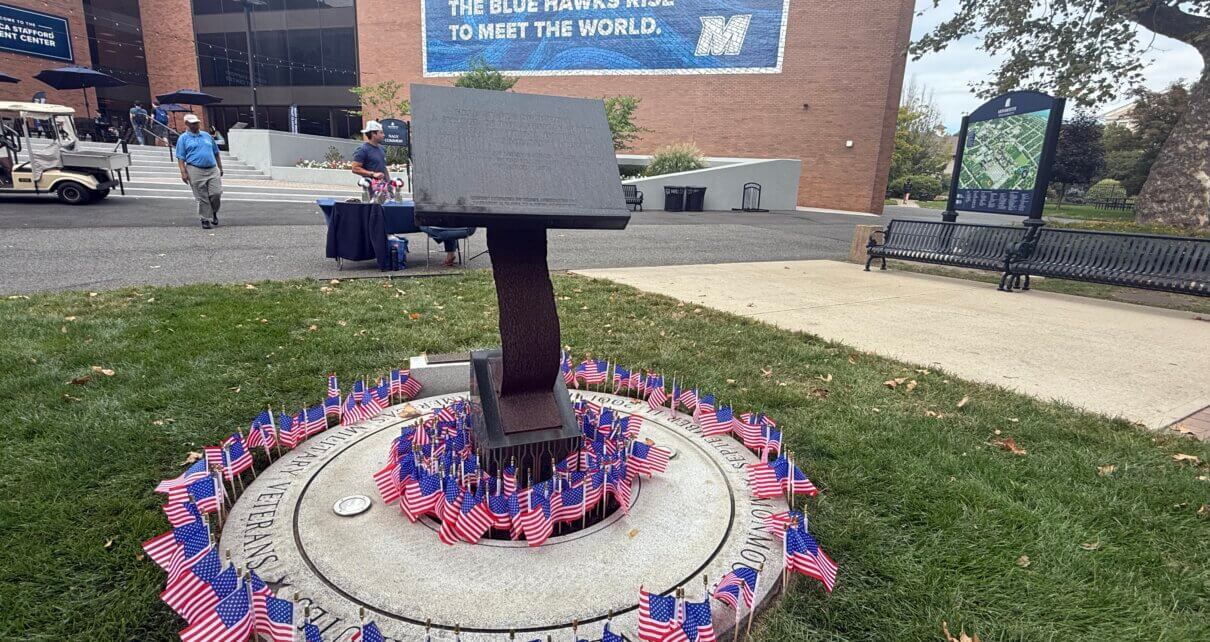
Twenty-five years ago, the Outlook devoted its first issue after Sept. 11 to documenting a campus grappling with an attack that had changed the country in a matter of hours. This year, more that 400 American Flags stood around the university’s 9/11 memorial by 11 a.m. as a new generation of students gathered to remember an event many were not alive to witness.
“That fact carries a particular meaning on our campus: for the first time, every traditional-age student in our community was born after the attacks, learning about the event rather than living it,” wrote Monmouth University President Patrick Leahy in an email to students the day before the anniversary.
But in 2001, all students on campus lived through the events of that day. That difference can be seen in the pages of the Outlook from Sept. 2001.
The Outlook published its first issue following the attack on the World Trade Center on Sept. 19, 2001. The 12-page issue, featured a front-page story titled “Aftershock.” It included six firsthand accounts from university students about where they were and what they experienced the day the attacks took place, along with coverage of campus reactions, blood drives, memorials for those lost, and the experience of students studying abroad.
The issue also included a question-and-answer with a freshman student who had lost a dear friend aboard United Airlines Flight 93, offering a personal account of the loss experienced by a member of the university community. When asked how her life had changed in the days following the attacks, the student said, “I look at things a lot differently now. I know not to take friends or life for granted.”
The issue also captured the ways students responded to the attacks on campus. A photograph showed an American flag painted by a student and displayed in a window of Redwood Hall, a residence hall that remains in use on campus today. The entire back page of the issue featured an American flag at half-staff, with the words, “We will never forget.”
On campus, across from Nagy Commons, sits the university’s 9/11 Veterans Memorial that was dedicated in 2013. The memorial is a podium, including an I-beam section that was pulled from the wreckage of the World Trade Center. The memorial was made possible through Life Trustee Judith A. Eisenberg and her husband Dr. Lewis M. Eisenburg. Lewis Eisenburg was the Chairman of the New York and New Jersey Port Authority during and after the 9/11 tragedy.
Monmouth University hosts a flag planting event on the day of the attacks every year. Nick Heckel is a senior homeland security major who stopped to plant a flag, he said, “It was a terrible day for our country so I want to remember everyone, it was a lot of people. A lot of my friend’s families worked there that day.”
Riley Huber, a sophomore, stopped with a group of friends at the memorial, “I stopped here because it is something so simple and it doesn’t take a lot of time out of my day to just show remembrance.”
The plaque in front of the memorial reads, “The Eisenbergs paid personal tribute to scores of 9/11 victims and surviving heroes thereby providing strength to our community.”
Colleen Reitmeyer, a sophomore secondary education major, reflected on the impact the terrorist attacks had on the country. She said, “9/11 was such a formative part of America’s more modern history and I think it’s important to honor the big loss of life that occurred on that day.”
To commemorate the 25th anniversary, in addition to the flags at the memorial, a 26-minute documentary titled, “Monmouth County 9/11 and Its Aftermath,” produced by the Monmouth County Clerk’s Office in partnership with the Monmouth County Historical Association.
Xochil Ramirez, Coordinator for Student Support and Veteran Services moderated the screening of the documentary that took place in the Great Hall Auditorium, the same site where the university held ecumenical services the days after September 11, 2001.
The screening was followed by a discussion about the lasting effects of September 11 on the region. Attendees recalled seeing abandoned cars at the Middletown train station in the days following the attacks and discussed the smoke that reached parts of New Jersey from Ground Zero. Students who were not alive on September 11 asked older attendees about their experiences and what it was like to live through.
Ahead of the screening, Leahy addressed the audience, acknowledging generational distance between current students and the events that occurred. “Part of what I believe is a solemn responsibility of educators is to make sure that these important events in our history and the lessons from them are passed on,” Leahy said.
“I really wanted to create an opportunity for all of us to remember those lives that were lost that day, but also to understand the impact of September 11th, particularly here within Monmouth County, from stories from locals,” he said.
Before the documentary played, Leahy concluded, “When I’m in the company of the people that I most love, I hold a hug with them firmer and longer than I normally do.”
Twenty-five years later, the university’s commemoration reflects the changing relationship between the campus and Sept. 11. What was once a firsthand experience for its students is now history that is taught, documented, and remembered.