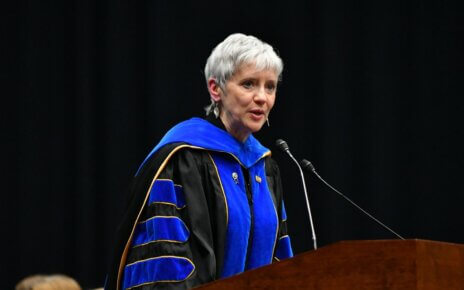
Kevin McClure, PhD, professor of higher education and chair of the Department of Educational Leadership at the University of North Carolina Wilmington, and author of “The Caring University: Reimagining the Higher Education Workplace After the Great Resignation,” spoke to Monmouth University faculty and staff Sept. 17 as part of the Dean’s Distinguished Speaker Series.
Hosted by Dean David Golland, PhD, of the Wayne D. McMurray School of Humanities & Social Sciences, the discussion focused on burnout, workplace culture, and how universities can better support the people who work within them.
McClure said his interest in the topic began with his own experience with burnout during the COVID-19 pandemic. In May 2020, he was teaching, coordinating a graduate program, advising students, and balancing work with caring for his young children. “I knew, in that moment, that something was wrong,” McClure said. “But I didn’t really have language or vocabulary to really express what was going on.”
He said he eventually recognized what he was experiencing as burnout. McClure said, “This was not the kind of tiredness that a nap was going to do the trick for. It was a really deep exhaustion, and it was a cognitive exhaustion. I had a lot of difficulty making plans, making choices. I was cynical about my work for the first time and asking, ‘what is my future in this job, if this is how I feel doing it?’”
After speaking with a counselor and colleagues, McClure began researching burnout and the higher education workforce. McClure is now six years into the research, including interviews with more than 100 faculty, staff, and students at institutions across the country.
McClure said his research changed how he thinks universities should respond to burnout. “This isn’t going to be a seminar or a talk about well-being in higher education that’s all about you taking better care of yourselves,” he said. “Because everything that I have learned up until this point points to the need for a different approach.”
“We need to instead be looking at our organizational practices. We need to be looking at our institutional cultures, our institutional structures,” McClure said.
McClure said universities can contribute to burnout through workloads, compensation, professional development, and opportunities for advancement. He said the responsibility cannot fall entirely on individual employees to manage those problems. “The literature on care ethics is very clear that we are not talking about niceness or kindness,” McClure said. “It’s about action that we take towards other people for whom we have assumed a special responsibility.”
He continued, “One is that we probably stop at the University as a collection of buildings to remind ourselves that the university is a collection of people. We are a university. It’s our labor, it’s from our relationships to each other, our relationships with students, and we make this whole thing possible.”
McClure outlined six organizational changes that institutions can make, including campus strategy, policies, career growth, and compensation.
“The campus strategy asks us to consider, as we are setting strategic priorities, are we considering the human thing?” McClure said. “Are we considering our capacity to fulfill those strategies with the people we have?”
During the question-and-answer portion, an attendee asked how McClure’s research could affect faculty members who do not want to move into administration.
McClure explained the traditional faculty career path can provide limited opportunities for advancement after faculty members move through the ranks. He said universities should create additional ways for experienced faculty to use their skills. “We need to create opportunities for faculty who have a lot to contribute and say, ‘I’ve been doing this for a long time. I’d like to do something else,’” McClure said, including giving faculty opportunities to work on curriculum design.
Another attendee connected McClure’s discussion to their experience working in the New Jersey Attorney General’s Office and in New York, where they experienced staff burnout and “doing more with less.” McClure said the organizational issues he discusses are not exclusive to higher education. “Higher ed sometimes like to think that we’re a little different from all these other places and we’re not that different from other places,” he said.
Zaneta Rago-Craft, Ed.D., founding director of Monmouth’s Intercultural Center and advisor to the president for diversity and inclusion, attended the presentation. She said McClure’s discussion showed that universities already have many of the foundations of a caring environment. “Inherent in our structure are the principles of being mission-driven, shared governance, and direct access to continuing education, professional development, and career mobility,” Rago-Craft said.
She said the challenge is making sure those opportunities are accessible and equitable. “I think McClure’s ideas are relevant to Monmouth as we continue to think about what kind of community we want to be,” Rago-Craft said. “A people-centered university means recognizing that faculty and staff are essential to the student experience, and that supporting employees ultimately strengthens our ability to support students.”
Amanda Stojanov, associate professor and media artist at Monmouth, also attended the event. She said McClure’s focus on the connection between working conditions and student learning stood out to her. “What stood out to me was his attention to the experiences of both staff and faculty, and the connection he made between those experiences and the student experience,” Stojanov said.
Stojanov highlighted McClure’s statement, “Faculty & Staff Working Conditions are Student Learning Conditions,” as a framework for understanding how workplace experiences can affect students. “For example, improving working conditions, such as equitable compensation and balanced workloads for faculty and staff, can cultivate a more supportive and engaged campus culture and thus a stronger learning environment for students,” Stojanov said.
Rago-Craft said some of the changes McClure discussed would not require significant financial investment. “Ensuring that job descriptions and titles accurately reflect people’s actual responsibilities and scope of work, making sure expectations are realistic and achievable, and authentically engaging with functional areas about their work experience and ways to improve it are all actions that can be taken across a university to help build a stronger sense of community,” she said.
She also emphasized the importance of connections between employees outside of their immediate departments. “People are more likely to feel a sense of belonging when they have opportunities to build relationships, find common ground, and learn from colleagues across the institution,” Rago-Craft said.
McClure ended the presentation by encouraging universities and individuals to focus on changes they can make rather than expecting immediate, institution-wide transformation. “We’re not aiming for perfection, we’re aiming for progress,” McClure said.