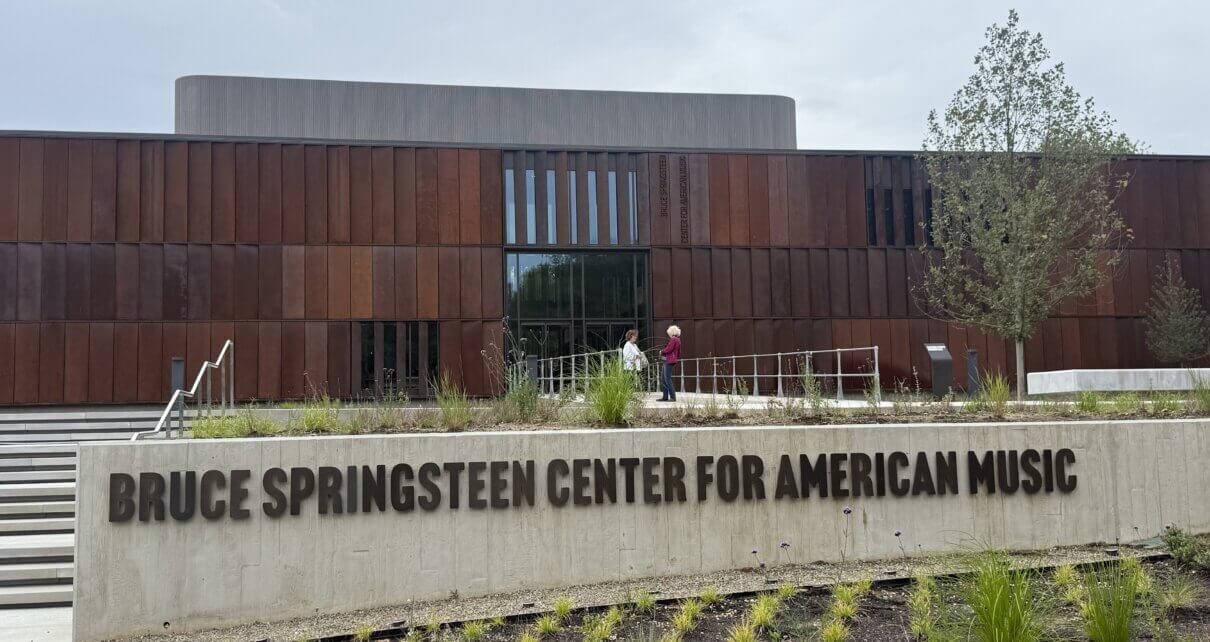
The Bruce Springsteen Center for American Music opened on Monmouth University’s campus on June 13, bringing exhibits on Bruce Springsteen’s career and the broader history of American music to a 30,000-square-foot building.
About 20,000 square feet of the building are dedicated to exhibits. Monmouth students can visit the center for free, but they must still reserve a ticket to enter.
The center features exhibits on Springsteen as well as temporary exhibits that are expected to change approximately two to three times a year. The inaugural rotating exhibit, “Chimes of Freedom: Protest, Patriotism, and the Power of Song,” looks at protest music throughout American history.
The exhibits span a variety of genres, including country, classical, hip-hop, sacred, and folk music. Visitors can also see artifacts dating back to the American Revolutionary War, including fifes from 1775 to 1783. Some artifacts are on loan from other museums and collections, including Hard Rock. The collection also includes more contemporary pieces, like stage outfits worn by artists such as Chappell Roan and Sabrina Carpenter, as well as a jacket worn by Elvis Presley.
Melissa Kozlowski, director of curatorial affairs, said the center’s focus extends beyond Springsteen to the broader history of American music. She said, “What we do is even more than Bruce, the Center for American Music, we look at all kinds of genres.”
Lori Levenson, a docent at the center, said she was drawn to the Center because of its focus on both Springsteen and American music history. “Not only was it going to be a center focused on Bruce Springsteen and the repository for all of his work, but also to cover the history of American music,” Levenson said. “It’s 250 years of what I think is just wonderful.”
Levenson said music provides a way to understand American history. “American music, the story of our history is told through songs and lyrics,” she said. “To me, it’s one of the most wonderful ways to tell a story is through music.”
The center has collected more than 48,000 artifacts and items, although not all are currently on display. Levenson said the collection now has a permanent home.
Interactive exhibits are a major part of the center. Visitors can play instruments and learn from members of the E Street Band through videos. Other exhibits use headphones, video, lighting and other audiovisual elements to allow visitors to engage with the material.
One room recreates the atmosphere of a Springsteen concert. A projector plays concert footage while concert-style lighting surrounds visitors. The walls feature a photograph taken from the pit at one of Springsteen’s shows.
Sofia Costa, a Monmouth student who visited the center, said the interactive exhibits stood out to her. “The exhibits inside were really interactive and contained a lot of information about Bruce,” Costa said. “I liked being able to go through the museum and picking up instruments or putting on headphones to learn more.”
Costa said the concert exhibit was particularly memorable. “The one thing that surprised me was the exhibit where you can go inside and it mimics what it’s like inside of Bruce’s concert pit,” she said. “I thought this was an incredible way to engage people in the museum.”
Another room serves as a theater where visitors can watch an approximately 25-minute film narrated by Springsteen. The film explores the influences of American music on his career and features locations significant to his history, including the Stone Pony and Asbury Park Convention Hall. The Wonder Bar was transformed to resemble the Freehold Cafe for the film.
In the film, Springsteen reflects on the influences that shaped his music and his early interest in performing. He also discusses the connections between music and the world around it. “You can’t pluck one string without others resonating around it,” Springsteen says in the film.
The film concludes by inviting viewers to “become a student of American music.”
The center’s design also incorporates elements of New Jersey and Springsteen’s career. A boardwalk-style pathway leads visitors to the building, referencing the Jersey Shore’s influence on Springsteen’s music. The building’s exterior features a rusted industrial appearance inspired by the industrial areas of New Jersey where Springsteen grew up.
Springsteen-related exhibits are located on the second floor and include artifacts from the 1970s through the present.
Kozlowski previously worked as a historian, archivist, and curator for the U.S. Army at Fort Monmouth before teaching at Monmouth for 18 years. She eventually joined the center, seeing an opportunity to educate a much larger audience. When deciding whether to leave the Department of History and Anthropology, Kozlowski explained her thought process, “If I go to the center, I will have the opportunity to educate roughly 50,000 people a year, you know there’s just so much opportunity to educate.”
Kozlowski said the center also welcomed about 200 guests a day during the summer, with attendance beginning to slow after Labor Day. It allows for new audiences, like class field trips to visit the museum. She said, “Seeing the guests just so, so happy, because they’ve had great conversations or they learned something new or they saw an artifact that transported them back to a moment in time in their life that meant something special to them.”
She continued, “It’s really gratifying to see the impact that it’s having on people.”
For Levenson, that connection between visitors is part of what makes working at the center meaningful. “There’s such common ground that you have with everybody that walks in,” Levenson said. “We all have connections.”
“It doesn’t matter where you’re from or your background,” she continued. “People connect, and being at a place like this is where you feel it the most.”
Having the center on campus has also brought attention to the university. “Over the summer when I went to see it, the building was packed,” Costa said. “It was bringing in a bunch of attraction which is always great to see.”
The center currently offers student positions in its archives and store, and Monmouth faculty members can bring classes to incorporate the center’s collections and exhibits into their coursework. “It’s really important that the center is useful to our students across campus,” Kozlowski said.
The center will also host events in addition to its exhibits. On Thursday, Sept. 24, it will host Jake Thistle’s official album release show.
For Costa, the center represents the university’s growth and the opportunities available to students “I think that the center means progression,” Costa said. “This university is progressing into a place where students can gain a bunch of opportunities.”