Beginning on July 27, the Monmouth University Campus Bookstore was outsourced to Follett Corporation.The Outlook set out to examine what led the university administration to this decision and to find out more about the Follett Corp. as a whole. We also wanted to understand what students, faculty, and employees could expect going forward.
The announcement was made via email sent to employees on July 15 by the Vice President and Chief Financial Officer, Andrew Brannen. The email outlined some of the reasons that led the university to partner with Follett Corp., “This partnership will allow the University to leverage national purchasing power that keeps costs down for students, utilize enhanced retail technology and inventory systems, and ensure ongoing reinvestment in the bookstore operation.”
This move to outsource the bookstore came as a surprise to many students and faculty but it is a part of a larger national trend of campus bookstore consolidation. The Lever, in their 2025 article titled, “How Wall Street Broke the College Bookstore,” explained some of the reasons for this consolidation trend. The article states, “…over the last several decades — as the rise of e-books and Amazon threatened the broader bookselling business — campus bookstore operations have increasingly been outsourced to private firms. Of the thousands of bookstores, only about 300 independent college bookstores remain.”
According to The Lever, “There are more than 4,000 campus bookstores across the country, and over half of them are operated by just two firms: Barnes & Noble Education, a publicly traded company that was spun off in 2015 from the Barnes & Noble bookstore empire, and Follett Higher Education, a bookstore operator now backed by the personal private equity fund of Tony James, the billionaire that once led Blackstone.”
Who is Follett Corp?
According to follett.com, Follett Corp. was founded in 1873 in Wheaton Illinois by Charles M. Barnes, when he opened a used book store. The corporation was in the hands of the Follett family for 150 years when its corporate entity and operating units Follett School Solutions Inc. and Follett Higher Education Group were sold to a private investment company in 2022. They named Emanuel Kolady the CEO of Follett Higher Education. Previously Kolady served as SVP, Head of Stores for the eastern half of CVS Retail.
Follett Corp. partnered with over 1,000 colleges and universities across the country, including the University of Chicago, Johns Hopkins University, and Tulane University, as referenced in Brannen’s email. According to follett.com, the number of partnerships as of 2026 is 1,100. Follett Corp. lists on their website a number of reasons why universities should partner with Follett including improving student affordability, upgrading campus retail experiences, and boosting academic success. In addition, they argue that the average savings to students for both digital and physical materials are around 30 percent. When Howard university, historically black college, in Washington D.C. entered the partnership with Follett Corp. in 2025, the media release published in “The Dig,” the news hub run by the University Communications, promised a whopping 80 percent savings on course materials. We contacted Follett Corp. employees on campus with questions about changes in bookstore operations and changes students can expect in pricing. After being told the inquiry had been directed to Follett’s campus relations team, The Outlook did not receive a response. After following up a week later, The Outlook still had not heard from the campus relations team. On the question about what Monmouth students can expect from the current bookstore, Brannen said, “Students can expect to see additional options when it comes to course materials. Follett has an extensive supplier network and established purchasing channels, giving students access to a broader range of course materials and flexible ways to shop, both in-store and online. Students will also continue to find Monmouth apparel and merchandise in the store. The selection will evolve over time to reflect student interests, campus trends, and the products that students are looking for most.”
For this story, we also looked at Follett Corp.’s business history.
According to Revelio Labs, Follett Higher Education employs 4,107 employees, down from 4,290 employees in 2024. The total number of employees fluctuated following corporate restructuring and with the sale of Follett School Solutions Inc. to private equity Francisco Partners, in Sept. 2021. Private equity acquisition led to rolling department eliminations, operational restructuring, and unreplaced position vacancies. According to the same source, Follett Higher Education Group, “Has historically engaged in recurring workforce downsizing, a trend that continues into 2026.” Some of the reasons stated by Revelio Labs are moves towards automation, digital storefronts, and all digital course material models. Follett has an average rating as an employer according to Indeed, a global job search engine, and Glassdoor, a workplace transparency and employer-branding platform, both owned by Recruit Holdings as of July 2026. According to former and current employees who can post on these forums anonymously, many like the flexible schedules and rank the overall work environment as positive, and over half are satisfied with their pay. However, others stress insecurity about potential layoffs and lack of benefits as a big negative. “ Last year, after less than a year of my employment, the company had significant cutbacks with no warning to the hundreds of employees who had been cut from positions that they have upheld for years…Initially, I was proud to say that I was working for this company. They seemed to provide more-than-adequate training. However, it’s all a facade…If you care about people, if you want to help students, if you care about higher education, if you care about making a difference, don’t waste your time,” posted one former employee under the name Dreams Diminish in 2014 on SimplyHired, another employee rating platform that gives Follett 3.6 out of 5 stars.
Company Plagued by Lawsuits
Over the years, Follett Corp. was involved in several lawsuits brought by publishers and students. For example, W.W. Norton filed a complaint on Apr. 17, 2024 in the Southern District of New York for missed payments on both digital and print sales. The lawsuit states, “Despite multiple demands for payment, Follett Corp. has failed to remit timely payment on both digital and print sales and currently is many months delinquent on its obligations.” According to publishersweekly.com, in Apr. 2024, Follett Corp. was delinquent on payments to the publisher W.W. Norton, totaling at least $8,337,126 at the time of the filing. Publisher’s Weekly reported that, “In addition to being paid what is owed, Norton is seeking damages, as well reimbursement of its legal costs and expenses.” On May 1, 2024, W.W. Norton filed a voluntary dismissal with prejudice, meaning claims cannot be refiled, rather than proceeding with a full trial or obtaining a formal court judgment, according to dockets.justia.com. Specific financial terms or settlement details of the resolution were not publicly disclosed. A few years earlier, in 2017, publishers Cengage, McGraw-Hill Education, and Pearson Education, also sued Follett Corp. for selling counterfeit textbooks, according to publishersweekly.com. The complaint claimed Follett Corp. through both of its college stores and distribution businesses, engaged in copyright and trademark infringement, and trademark counterfeiting, by selling counterfeit copies of the plaintiff’s books.
According to The University of North Dakota’s student-run newspaper, Dakota Student, on Oct. 10 2017, Follett Corp. agreed to adhere to the Anti-Counterfeit Best Practices that the Educational Published Enforcement Group (EPEG) established March 1, 2017. In a press release published by EPEG on June 21, 2017, stated, “Publishers routinely (found) counterfeit textbooks being sold in large quantities in Follett’s stores, from Follett’s many online sites, and by Follett’s wholesale operations.” We sent Follett Corp. several emails over the last two weeks, as well as called their corporate offices for their comment but did not receive a response.
In 2007, two Daytona Beach Community College students sued Follet Higher Education Group and DBCC for unfair and illegal pricing and underpayment for buyback of used textbooks. The suit was dismissed in 2008 on the basis that the students were nonresidents and the students had not proved they had incurred sufficient damages, according to Chronicle of Higher Education. While this case was dismissed, concern over pricing of textbooks in Fallett Corp. run bookstores persists. In 2024 at the Santa Barbara City College in California, as reported by The Channels, a student-run-newspaper, faculty and students shared their concerns with textbook pricing and availability, “Faculty and students have noticed textbook price increases of up to 50% compared to last year. Additionally, textbooks are missing from the online database, making it difficult for students to access required course materials.”
Follett at Monmouth: What to Expect?
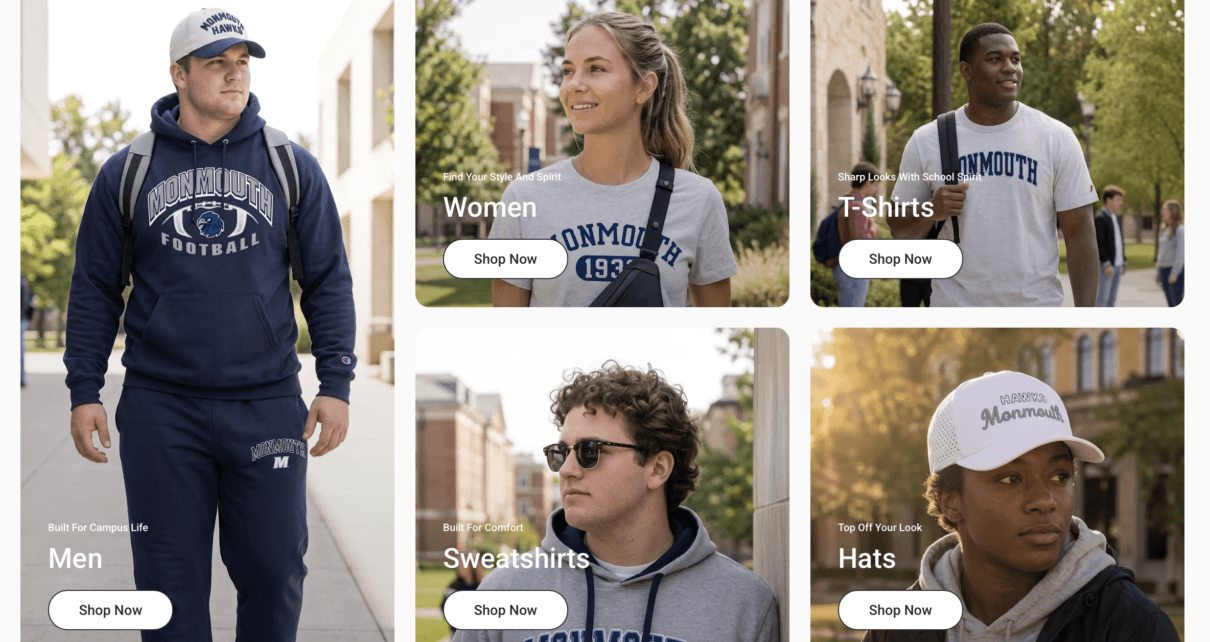
Follett Corp. has been operating at Monmouth University since the summer but there is no significant observable change on the Monmouth public pages. Some of the old pages are accessible but not operational. The staff page for the bookstore on the Monmouth website reads, “Page not found. The link may be incorrect, or the page has been removed.” Some students also noticed that the images on the revamped bookstore website portray people in Monmouth merch (t-shirts, sweatshirts, hats, etc.) clearly displaying the Monmouth logo, but the buildings behind them are not on Monmouth’s campus. Similar images were found on other college campus Follett Corp. bookstore pages, with Towson University most resembling that of Monmouth.
Monmouth’s bookstore previously had a self-operated model, and the University directly handled all of the store’s operations according to Brannen. “As part of an assessment of the store operations, we undertook a Request for Proposal (RFP) process and sought proposals from operators that manage stores on behalf of colleges and universities,” Brannen said.
He continued, “In early 2026 an advisory committee, with representation from academics, SGA, student life, marketing, athletics, and finance, was established to assist with the review of the RFPs. At the conclusion of the RFP review process, it was determined that the store’s overall performance would benefit from partnering with a retailer that manages university stores nationwide and brings extensive industry experience and expertise.”
Brannen explained that the administrators goal, and the goal of the advisory committee is to create a better overall experience for the students. “Most importantly, our goal is for students to have an improved and more convenient experience at the store. Whether they are purchasing course materials, picking up school-branded apparel, or shopping for everyday supplies, students will have access to the products and options they need, both on campus and online.,” he said.
We asked students whether they noticed any significant changes in the way the bookstore is operated, staffed, stocked, and about merchandise pricing.
Isabella Lemke, a recent MU alum, started graduate school at Monmouth this semester, and went to the bookstore during the first week of class. She said, “I went the weekend the freshman moved in. The bookstore lacked most sizes and was already sold out of all the things I went in looking for. I think I paid more for just a pair of sweatpants than I did in previous years. I wanted the classic Monmouth sweatpants and PJ pants and they did not have the sweats at all, and they only had the PJ pants in kid sizes.”
She continued, “I was disappointed that the bookstore got rid of their classic Monmouth merch. There were no basic Monmouth tees.”
Riley Kindler, senior music industry major, said, “It looked very similar to when I had been there before, except the clothing layouts were a bit different, definitely more organized. My books were a lot cheaper! Merch looked pretty much the same, but seemed more expensive. I will say they are definitely understaffed which is super unfortunate because the bookstore is very helpful for students. I also think ordering online was a lot easier this year!”