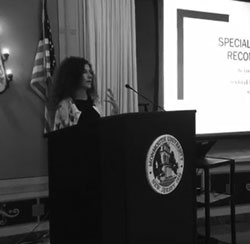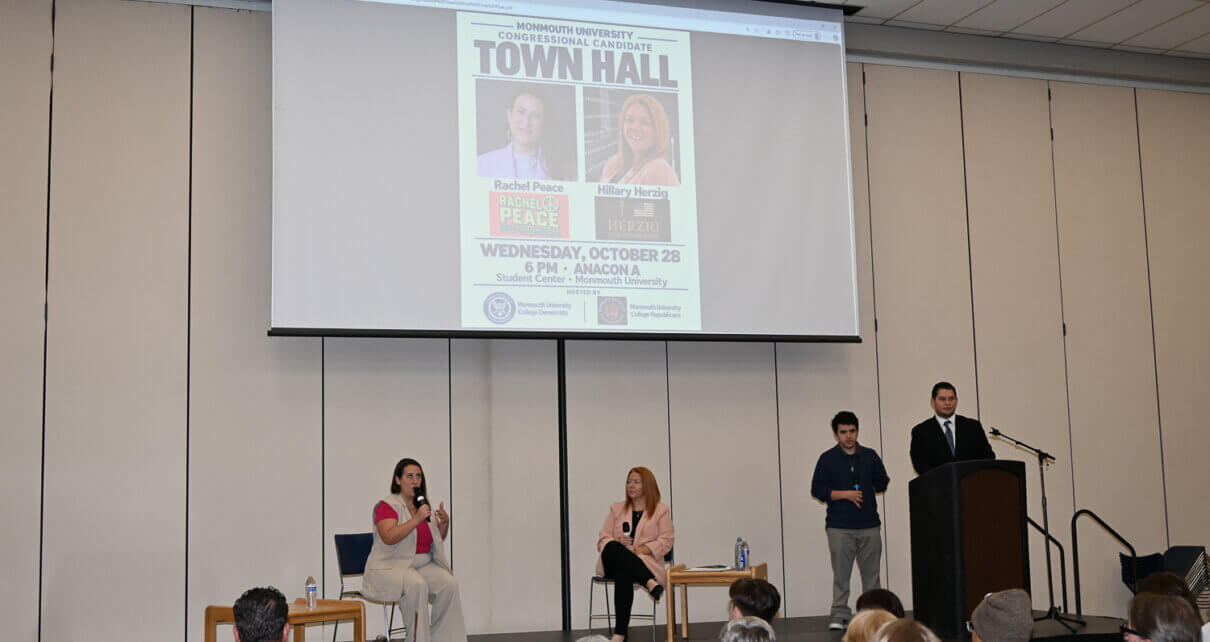
With the Nov. 3 midterm elections yesterday, two New Jersey congressional candidates visited Monmouth University last week to discuss their campaigns, address issues affecting local communities, and answer questions from students and attendees ahead of Election Day.
On Wednesday, Oct. 28, Monmouth University’s College Democrats and College Republicans jointly hosted a Congressional Candidate Town Hall featuring Rachel Peace, the Democratic candidate for New Jersey’s 4th Congressional District, and Hillary Herzig, the Republican candidate for the 6th Congressional District.
The event took place in Anacon A in the Student Center, bringing together students and community members for a discussion on affordability, environmental concerns, artificial intelligence, government accountability, and other political issues.
Peace is challenging Republican Rep. Chris Smith, who has served in Congress since 1981, while Herzig is running against Democratic Rep. Frank Pallone Jr., who has held his congressional seat since 1988. Although the candidates are running in separate districts, both races include communities in Monmouth County.
During her opening remarks, Peace thanked both student organizations for organizing the event and emphasized the importance of engaging younger voters.
“I think it’s very important to reach younger voters, engage them, and hear directly from them regarding what are their concerns,” Peace said.
Peace, a small-business owner and mother who grew up in Ocean County, discussed her background in public relations and her decision to enter politics after becoming frustrated with issues affecting her community.
Herzig, a mother of three and former federal employee, described her experience working for several government agencies, including the Department of Homeland Security, Department of Defense, and Department of Veterans Affairs.
Herzig explained that after returning home after serving her country, concerns over neighborhood flooding in her congressional district and difficulties acquiring assistance from her representative contributed to her decision to run.
“I hope to bring new ideas, new generational change, and real reforms to Congress,” Herzig said.
One of the first questions concentrated on New Jersey’s cost of living and whether college graduates would be able to afford remaining in the state after graduation.
Peace addressed housing affordability, describing the difficulties younger generations face when trying to rent or purchase homes. She pointed to Monmouth graduates living together because of housing costs and proposed changes to federal affordable housing eligibility requirements.
“I would like for the federal government to change the thresholds by which they are measuring whom is eligible for certain housing vouchers,” Peace said.
She also called for additional workforce housing that would provide options between income-restricted affordable housing and more expensive luxury developments.
Herzig discussed the role of energy costs in affordability, proposing greater investment in solar energy and alternative farming methods.
“I believe that diversifying our energy is the most important thing that we can do to bring down cost in the tri-state area and also in our country as a whole,” Herzig said.
She proposed installing solar panels on warehouses and residential buildings rather than productive farmland. Herzig also supported expanding indoor farming and hydroponic technology to reduce food transportation costs.
Environmental issues were another topic addressed during the discussion.
Peace spoke about climate change and its effects on coastal communities, including flooding, marine ecosystems, and infrastructure. She proposed requiring fossil fuel companies to help fund improvements designed to protect communities from environmental damage.
Herzig put emphasis on environmental health concerns, including contaminated sites in New Jersey, and called for greater investment in clean air and water technologies.
The discussion would then turn its attention to artificial intelligence and the growing number of proposed data centers across the country.
An audience member asked Peace about the NJFX data center in Wall Township and her position on the expansion of artificial intelligence facilities.
Peace said she has participated in local government meetings opposing data center developments and expressed concerns about environmental impacts, privacy, and the future workforce.
“We need that paused. We need a moratorium and we also need to regulate AI itself, not just pause the construction of the data centers,” Peace said.
Herzig proposed a different approach, arguing that policymakers should evaluate both the potential benefits and environmental consequences of data centers before determining where they should be constructed.
“We need to be smart about the guardrails we put in place and the placement of these data centers,” Herzig said.
Both candidates also expressed opposition to Flock Safety cameras and automated license plate recognition systems, raising concerns about government surveillance and potential exploitation of personal information.
Herzig said she opposed the widespread use of license plate readers, maintaining that Americans should not be subjected to extreme government surveillance.
Peace agreed, mentioning similar worries about privacy, data security, and the likelihood of surveillance technology being used improperly.
The candidates also assessed subjects where their positions differ from those traditionally associated with their political parties.
Herzig expressed support for congressional term limits and federal cannabis reform, including changes that would allow legal cannabis businesses greater access to financial services.
Peace said she would refuse corporate political action committee contributions and emphasized her intention to represent constituents rather than follow party leadership on every issue.
Audience members also raised questions about international conflicts and the economy.
When asked about the ongoing war involving Iran, Herzig said she opposed prolonged military involvement and believed American resources should instead be directed toward domestic concerns.
“I do not support any prolonged wars that put our American soldiers at risk,” Herzig said.
Another question focused on rising grocery and gas prices. Herzig again emphasized local agriculture, energy diversification, and government policies aimed at reducing household expenses.
Toward the conclusion of the event, both candidates reflected on the challenges of campaigning against longtime incumbents.
Peace discussed difficulties gaining political and media exposure, while Herzig described using technology and grassroots campaigning to reach voters despite financial disadvantages.
Both encouraged attendees to research candidates beyond political party affiliation and consider their positions before voting.
In their closing remarks, the candidates addressed students directly, emphasizing civic involvement and the importance of younger generations participating in government.
Herzig encouraged students to pursue new ideas and become involved in shaping their communities, while Peace proposed creating a youth policy council to bring younger perspectives into congressional decision-making if elected.
Each candidate concluded by thanking attendees for participating in the discussion and encouraging them to remain engaged in the political process.
“Every single one of you even sitting here tonight is making a difference by being here, by choosing to show up, by choosing to become informed,” Peace said.