Monmouth University’s Model United Nations (MUN) team competed in two conferences in consecutive weeks, sending students to the United Kingdom and Washington, D.C., to represent countries, debate international issues, and compete against students from universities around the world.
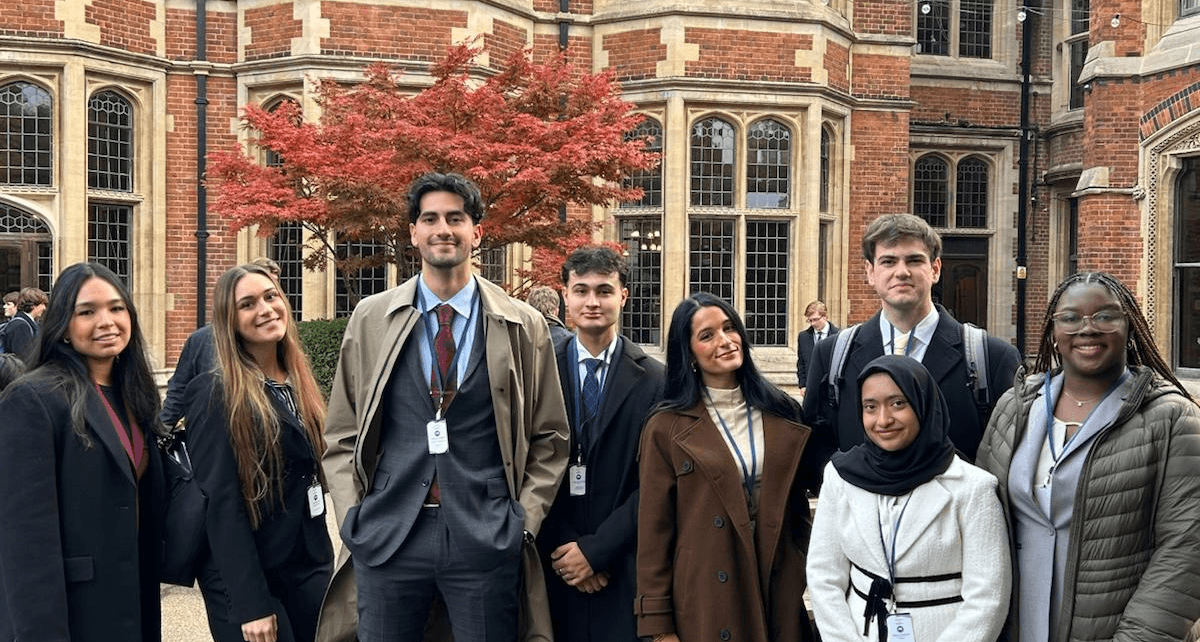
Eight students and Chair of the Political Science Department Dr. Mitchell traveled to the United Kingdom to participate in the Oxford International Model United Nations (OxIMUN) conference from Oct. 30 to Nov. 1. The team later sent 40 students to the National Model United Nations (NMUN) conference in Washington, D.C., from Nov. 6-8.
According to the OxIMUN website, the conference brings together delegates from different countries and backgrounds to discuss global issues, hear guest speakers, and participate in social events. Organized by students at the University of Oxford on behalf of the Oxford University United Nations Association, the conference traces its history to Model League of Nations debates held in Oxford as early as 1921.
During the conference, students represented assigned countries on various United Nations (UN) committees and used UN procedures to discuss international challenges and develop potential solutions.
OxIMUN took place throughout the University of Oxford campus, with committees hosted by different colleges, including Christ Church, Exeter, Pembroke, and Jesus. Opening and closing ceremonies were held at the Oxford Student Union Hall, and participants also attended a formal dinner at St. Anne’s College.
Four Monmouth students received individual awards for their performances at the conference.
Junior Kym Davis received the Delegate award for representing Côte d’Ivoire on the United Nations Educational, Scientific and Cultural Organization (UNESCO) committee. Senior Chris Feliks received Best Position Paper for representing France on the UN Security Council committee, which debated the 2011 Libyan crisis.
Junior Warda Chowdhury received Best Speech for representing Germany on the UN Security Council, while sophomore Sebastian Delgado received Best Speech for representing Iran on the United Nations Convention to Combat Desertification committee.
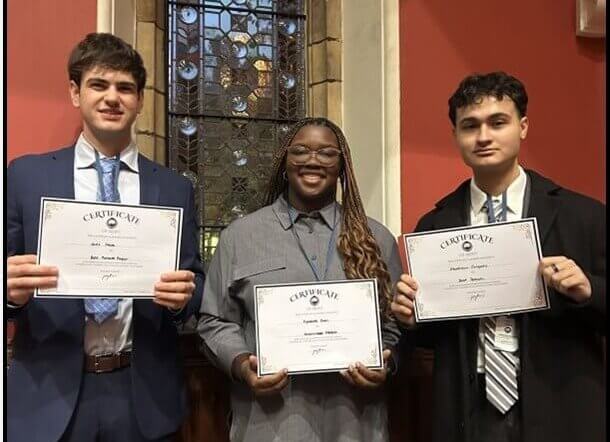
Davis said she spent hours researching, developing clauses, and practicing French pronunciations before the Oxford conference.
“To know that the countless hours that I spent preparing by researching, trying to find a memorable acronym to name my clauses, practicing my French pronunciations, and so much more; went noticed created a feeling that was truly indescribable,” Davis said. “If I had to choose one word to express myself, I’d pick gratitude.”
Davis said negotiating with delegates from countries with different positions and getting to know other participants outside committee sessions also contributed to her performance.
“I think being able to diplomatically negotiate with both Ally and countries and opposing countries., going on coffee chats, and getting to know each delegation outside of just the country that represents—that all shows up when you step in the committee room and aim to win,” Davis said.
Feliks, a senior, said representing France on the Historical Security Council was one of the most challenging Model UN committees he had participated in. The committee discussed the situation in Libya in 2011, which involved several political figures and international organizations, including NATO, the Arab League, and the African Union.
As a permanent five (P5) member of the Security Council, France had additional responsibilities during negotiations.
“As a Permanent 5 (P5) country, I had the additional responsibility of negotiating with other P5 countries to prevent a veto vote from happening (which did not always work in my favor),” Feliks said.
The committee included experienced delegates, Feliks said.
“Since my committee was one of the two ‘Advanced’ committees at the conference, I knew that every other student in the room would be very well prepared to tackle this issue, which pushed me to research as much as possible about the 2011 Libyan Crisis,” Feliks said.
His preparation included reviewing previous UN Security Council resolutions, articles about Libya and the Arab Spring, and French international policy. Feliks said receiving the Best Position Paper award recognized the work he completed before arriving in England.
“Receiving the Best Position Paper award showed me that the chairs of my committee noticed all of the hard work and research I put towards this conference even before arriving in England,” Feliks said.
He explained that position papers serve as research blueprints for delegates before committee sessions begin.
“I have won other awards in the past (including the ‘Best Negotiator’ award at last year’s Oxford International MUN (OxIMUN)), so I knew I have what it takes to win an award, but I did not take my skills for granted,” Feliks said.
As one of the team’s student captains and head delegates, Feliks also helped prepare the Monmouth delegation before the conference. He said all eight students had participated in at least one previous Model UN conference, so they were familiar with the committee procedures.
Feliks said the international trip also allowed students to meet participants from other countries and explore the University of Oxford.
“These conferences are so much more than what happens in the committee room,” Feliks said. “They include meeting people from the complete other side of the world, exploring the various Colleges that are a part of Oxford, and also attending the social and black-tie dinner that the conference arranged.”
Senior Anthony Tesoriero, a business administration and political science major who has participated in MUN for three years, also attended both conferences.
At OxIMUN, Tesoriero participated in the Gangland crisis committee. At the Washington, D.C., conference, he represented a country on the Economic and Social Council (ECOSOC), where delegates discussed access to education in areas affected by conflict.
“I participated in the ECOSOC committee, where we discussed ensuring access to quality education in conflict and post-conflict zones,” Tesoriero said. “We developed solutions on that topic, researching what the UN has done so far and how to build on existing solutions.”
Tesoriero said the two conferences provided different competitive environments and opportunities for students with varying levels of Model UN experience.
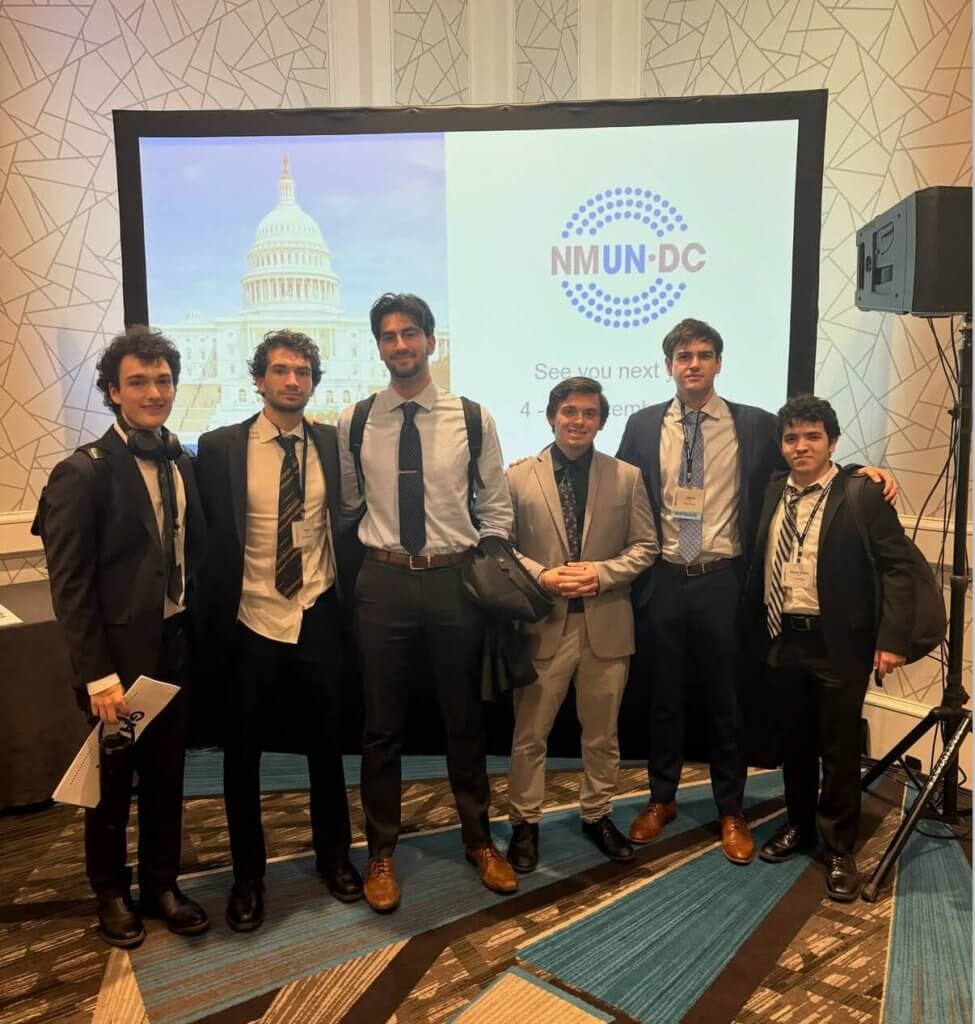
The Washington, D.C., conference is often attended by larger delegations and provides resources for students who are new to Model UN. Oxford, however, brought together more experienced delegates with stronger backgrounds in international relations and global politics.
“The D.C. conference is often used by large delegations to bring members who have never done Model UN before, because its structure and resources help new delegates learn the procedures and inner workings of the UN,” Tesoriero said.
“As a result, you see a lot of students come into their own strategies for doing well in competition,” he said.
Tesoriero said the Oxford conference required a different level of preparation because of the experience of the students competing.
“Oxford, on the other hand, has many seasoned competitors with a very strong understanding of the UN and global politics,” Tesoriero said. “That requires a deeper understanding on our end, as well as strategies that are already developed, to go head to head with these students.”
Davis represented the Commonwealth of Australia on the International Organization for Migration (IOM) committee at the Washington, D.C., conference. Delegates discussed global migration standards, including pathways for migrants, technological advancements, and the recognition of labor and skills.
“The Washington D.C conference went phenomenal overall,” Davis said. “From the moment we stepped in the bus to the moment we sat in the closing ceremony, the vibes between the team were electric. We were eager to defend our countries positions and even more so to meet other delegates.”
Davis said the two conferences offered different experiences. “They were both equally unique in their own ways,” Davis said. “There’s definitely a difference between being able to compete nationally and take home team awards and then being able to go internationally to a country with such a rich litigious history and experience a bit of that there for yourself.”
The National Model United Nations conference in Washington, D.C., brought together hundreds of college and university students from around the world to participate in discussions on international relations. The 2026 conference featured eight simulated UN committees, including a Security Council crisis simulation, and keynote speakers.
According to the NMUN website, the organization is the world’s largest and oldest ongoing university-level Model UN program. Its conference procedures were developed with the United Nations Institute for Training and Research (UNITAR), and the organization has been formally associated with the UN Department of Global Communications as a nongovernmental organization since 1982.
Tesoriero attended both conferences during his final year with the organization. “The most memorable part of D.C. was knowing it was my last year attending,” Tesoriero said. “I remembered being brand new to the experience, and it was rewarding to watch our members perform so well in front of students from all over the world.”
He said competing against students from universities with established Model UN programs also showed him the abilities of Monmouth’s delegation.
“The biggest thing I took away from both conferences is how strong our Monmouth students are when competing against top schools from around the world,” Tesoriero said. “I have seen students, myself included, go head to head with delegates from Oxford University, the University of Dallas, King’s College London, and more.”
Tesoriero said he was proud to represent the university through the organization’s participation in the conferences.
“I am honored to be part of the Model UN team and to represent our school on the world stage,” Tesoriero said.
Students interested in joining Monmouth’s Model United Nations team can contact student captains and head delegates Warda Chowdhury or Chris Feliks.