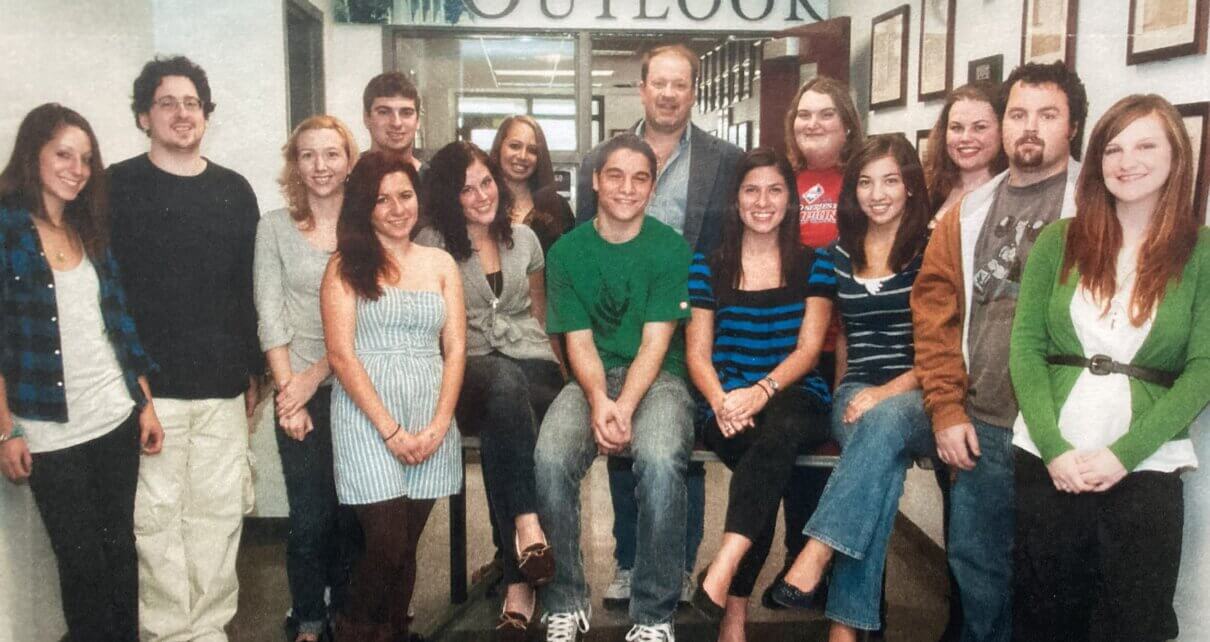
At The Outlook, Professor John Morano became the steady presence behind the newsroom, guiding generations of student journalists before stepping down as faculty advisor in 2021. He is now retiring after 38 years at the university.
Morano, who was hired to found Monmouth’s journalism program, also became the first faculty advisor in the paper’s history. From the beginning, he made one thing clear; The Outlook belonged to the students.
“The first thing I did when they brought me in was write my letter of resignation,” Morano said. “I signed it and gave it to the editor and said, ‘Put that in your desk. The moment you feel I do not have your best interests at heart, or I am not here for you first, you can use it.’”
That letter sat untouched for over 30 years.
Over his 33 years as an advisor, Morano oversaw more than 800 issues of The Outlook. Under his leadership, the paper earned national recognition. The Outlook won five national championships from the American Scholastic Press Association (ASPA), one national championship from the Society of Professional Journalists, and was awarded ‘Top Ten in the Nation’ from the Associated Collegiate Press. Of those five ASPA National Championships, The Outlook won back-to-back twice.
His approach was consistent. He treated the newsroom like a team, but never tried to control the outcome.
Julian Garcia ‘96, Editor-in-Chief, remembers that balance. “He was a really good guiding force for us at the paper. He was very hands-on. He always showed up for us, but at the same time, he didn’t take control. He gave us advice, told us what he thought was best, and then stepped away and let us do what we needed to do.”
Garcia said that freedom was essential. “I think that was the best way for us to learn. Not having him constantly looking over our shoulders but giving us guidance and then allowing us to succeed or fail. Of course, he would step in if something was egregious or could get us into trouble. But for the most part, he balanced being hands-on while knowing when to step away.”
That trust gave students room to figure things out on their own, even when it meant getting something wrong the first time.
Greg Mescall ‘03, sports editor, and now a regular calling play-by-play on ESPN and Fox Sports, as well as the voice of USA Women’s Water Polo, remembers one of those moments early on. “I remember working on a story as a freshman that admittedly was not ready for prime time, but he let it run anyway and it was the best learning experience. … We spent time after breaking down how to do it better next time.”
For many, Morano served as both a guide and a steady presence in the newsroom. Garcia reflected on that dynamic. “But on my end, I always looked up to him. I never felt like we were side-by-side.”
That perspective only deepened over time. After leaving Monmouth in 1996 and working at the Daily News, Garcia began to understand the long-term value of that mentorship. “As I got older, I realized I needed his guidance even more than I did in college. He became a great resource, someone I could bounce ideas off, especially when I had challenges or was looking for new opportunities.”
Garcia continued, “And that’s one thing I want to emphasize, he’s changed the least of anyone I know. He’s the exact same person he was 30–35 years ago, both in personality and how he treats students and alumni.”
Terry Lipshetz ‘98, who served as sports editor, managing editor, and Editor-in-Chief, and is now the National Newsroom Managing Editor for Lee Enterprises, said Morano’s influence extended far beyond the newsroom.
“You get to college and you’re just an 18-, 19-year-old kid mostly away from home for the first time, and here is this professor who is not only a key instructor in what you hope leads into your career, but offers the qualities of mentor, older brother, father-figure and life coach,” Lipshetz said. “Next to my parents, there is nobody during this four-year period of my life that had a greater impact on me.”
He also pointed to the balance Morano maintained between independence and accountability. Lipshetz explained, “Professor Morano always popped in to make sure all was well. What would be our front-page stories? If we had something controversial, did we have the proper sourcing? Yes, this was a fun student-run organization, but it’s serious work, too, with real-life implications if you get things wrong.”
Students also learned through adversity, something Morano did not shield them from.
Garcia reflected on those moments. “We had moments where things didn’t go our way, and we learned from failure. He taught us persistence, strength, and how to deal with adversity.”
Jennifer Knoeppel ‘05, now the Managing Director of Communications for NASCAR, said the experience pushed her beyond her comfort zone. “The Outlook itself pushed me out of my comfort zone. I wasn’t the strongest writer, and I didn’t always feel creative when it came to generating story ideas. There were times when I wanted to quit because it was time-consuming and I had other commitments.”
She added, “But he encouraged me to stick with it, reminding me that it would get easier. Over time, it did. I found a rhythm, and it became more natural. That experience really helped me grow, both professionally and personally.”
Morano saw that development as the purpose of the paper. He said, “The best part of the experience was seeing students grow, gain confidence, and realize what they were capable of. The goal was to create a space where anyone could participate and learn.”
In the April 21, 2021 issue of The Outlook, the final issue Morano advised, former students wrote in and submitted messages of gratitude.
Caroline Masttise ’20 wrote, “It was one of my favorite teams that I have been a part of and you will certainly go down as the winningest coach in paper history.”
Courtney Buell ’18 wrote, “What is unique to Morano’s approach to advising is he has provided tools that are valuable outside of the classroom. By instructing without governing, he has allowed his students to rise to their full potential and become self-reliant.”
Even in stepping away, Morano stayed true to that philosophy. “When I stepped down, I stayed out of the newsroom completely. I knew I was handing it to someone capable, so I did not go back in. Once it is no longer your responsibility, you have to let it go,” Morano said.
After nearly four decades at Monmouth, his presence is still easy to picture.
While he is set to deliver his last lecture at the university, he can still be found in his office, where rock music plays quietly as papers are spread across his desk. Glasses rest at the tip of his nose as he reads. Awards line the walls, and shelves hold typewriters, photos from his life, and worn ticket stubs from concerts, shows, and his years in journalism.
But his legacy is not just on the walls. It is in the people who still call him years later.
Mescall still keeps in touch. “He is someone I routinely check-in with, grab lunch, etc. to talk about the latest steps in my sports media journey. Even as I moved more into broadcasting and not as much writing, his thoughts and ideas are always valuable. He is good for a pep talk and we’ve long bonded over our love of basketball and the NY Knicks.”
Mescall concluded, “I’m fortunate to know him and call him a friend and a mentor. I know I’m just one of many, many students he’s impacted in this positive way. He leaves massive shoes to fill at MU.”