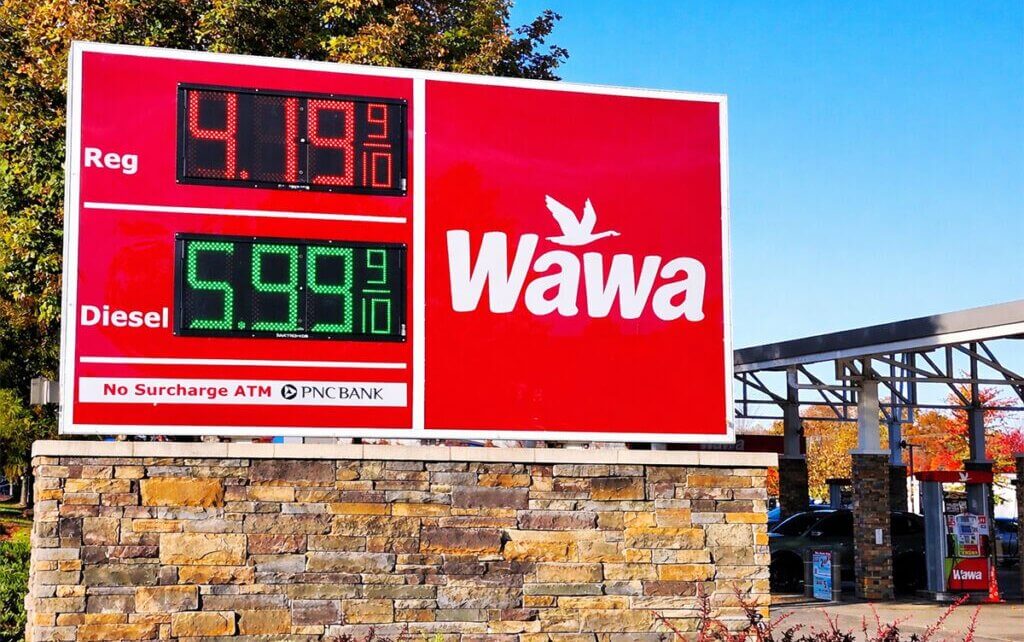
Drivers across the Garden State are beginning to feel the brunt of the escalating war between the United States, Israel, and Iran, as rising oil prices drive gasoline costs closer to $4 per gallon.
Oil prices have skyrocketed past $119 per barrel as fighting has intensified and shipping through the Strait of Hormuz slowed sharply, according to Reuters. The narrow waterway carries roughly one-fifth of the world’s oil supply, making it one of the most critical shipping routes in global energy markets.
For New Jersey residents, the consequences are becoming increasingly evident at the pump. While the state average is approaching the $4 mark, with some areas already reaching that mark, national trends indicate prices have now crossed it. According to AAA statistics reported by Reuters, the U.S. average gas price has climbed to just over $4 per gallon for the first time since 2022, largely caused by the recent oil supply interferences linked to the Iran conflict. Local averages in New Jersey have gradually increased in recent weeks, jumping from $3.50 earlier in March to nearly $3.90 in many regions, suggesting that drivers across the Garden State are likely to see $4 gas become the norm if global tensions remain.
Monmouth student and New Jersey resident Abby White has already felt the hardship of commuting to school during the week. “My commute to Monmouth is about fifty minutes to an hour. I already spend over $70 on gas, which is not typical for me. If gas prices continue to rise as they are, it’s definitely going to affect my spending and will have to cut down on other needs,” said White.
Economists warn that the spike in oil prices is precisely tied to the instability in the Gulf region. Adnan Mazarei, a senior fellow at the Peterson Institute for International Economics and former International Monetary Fund official, said the scale of disruption is unprecedented.
“The war with Iran has brought about the largest disruption ever in oil markets,” Mazarei said, noting that nearly 20% of global oil flows through the Strait of Hormuz.
That disruption is already rippling through the U.S. economy. Analysts at Goldman Sachs say rising oil prices tied to the conflict will likely push inflation higher, particularly through increased transportation and energy costs.
“Most of the impact of the war on U.S. inflation will come from higher oil prices,” Goldman economists said.
For New Jersey residents, that means higher costs not just at the gas station, but across everyday expenses. Increased fuel prices often lead to higher costs for groceries, delivery services, and travel, as businesses pass on rising transportation expenses to consumers.
Energy analysts say the situation could worsen if shipping disruptions continue. Tim Skirrow, head of energy derivatives at Energy Aspects, warns that limited oil flow through the Gulf could lead to supply shortages.
“$150 a barrel oil will certainly cause a demand shock, but as long as oil cannot flow out of the Gulf, there will be risks of outright shortages,” Skirrow said.
New Jersey is particularly susceptible to global oil disruptions because it relies on imported fuel. Northeast states depend on foreign shipments and infrastructure like pipelines and ports to uphold supply. According to the U.S. Energy Information Administration, the East Coast produces a small fraction of the fuel it consumes, making it more vulnerable to global supply shocks and price hikes when overseas shipping routes—such as the Strait of Hormuz—are interrupted. This dependency means that geopolitical conflicts abroad can initiate greater gas prices for drivers in New Jersey than in other parts of the country.
Danielle Williamson, a junior at Monmouth University from New Jersey, says rising gas prices have made her daily routine significantly more expensive as she balances school and work.
“Commuting to school has definitely gotten more expensive with gas prices being so high right now,” Williamson said. “My car takes premium, so I’m paying around $4.79 a gallon, depending on where I go, and it adds up really quickly. Between classes and work, I’m driving almost every day, and now I’m filling up once or even twice a week.” She added that the increase has forced her to budget more carefully and has made commuting more stressful than it used to be.
Experts say the longer the conflict continues, the more likely it is to sustain higher prices and strain global markets, with local effects directly felt in places far from the Middle East, including New Jersey.
“When traffic through the Strait comes to a halt, it doesn’t stay a regional issue,” Mazarei said. “It becomes a global economic shock.”