
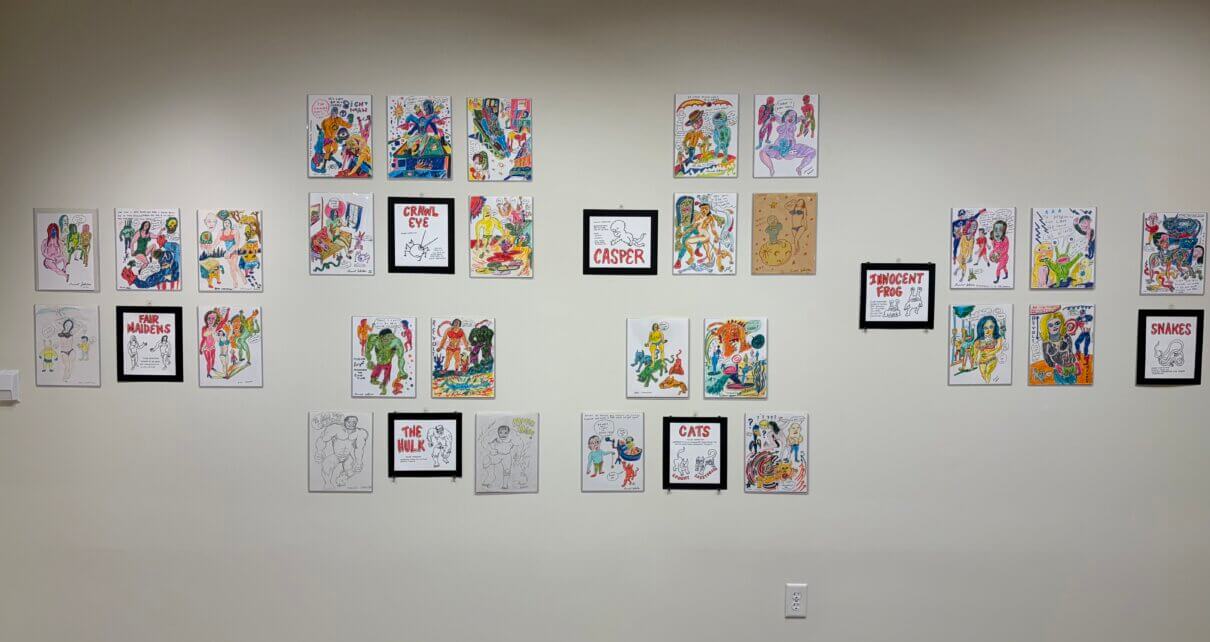
Behind the doors of Rechnitz Hall sits numerous creations by Daniel Johnston, a singer-songwriter and visual artist whose inner-mind came to life through art. The Monmouth University Department of Art & Design welcomes all to observe “I am a Baby in My Universe II,” which is available to the public Monday-Friday until December 15.
The exhibition, curated by his sister, Marjory Johnston, features his distinct and deeply expressive universe. It offers an intimate view into the human psyche, with colorful pen and marker drawings capturing his personal struggles with manic depression and schizophrenia.
His work has earned admiration from rock stars like Kurt Cobain and Tom Waits as well as newspapers and magazines like The New York Times and The New Yorker, according to the university’s Department of Art & Design.
Johnston’s most famous drawing is captioned, “Hi, How Are You?” and features a sociable, antenna-eyed frog named “Jeremiah the Innocent.” Additional characters include the “Fair Maidens,” who were inspired by the women he knew, saw, and met, “The False Prophet,” who he based off of biblical scriptures, and others that he borrowed from artists such as The Hulk and Casper the Friendly Ghost.
But beyond the characters and vivid illustrations lies a deeper meaning.
Johnston’s work is an incredible representation of the relationship between artistic expression and mental health. And for some, visual art provides an avenue to communicate the things they sometimes can’t find the words for.
Susan Meyer, a specialist professor for the Department of Art & Design, reinforces the idea that art can be used as an outlet.
“Visual art is a way of communicating; one that, often, does not involve words. Some people find ways to connect with and explore the human experience more readily through visual art than through other forms of communication,” said Meyer.
Katarina Burton, a junior majoring in social work, explained that it is harder for those dealing with a mental illness to verbalize how they feel.
“There’s usually a feeling of distress, but they can’t exactly pinpoint if it’s a source of anger, sadness, or any other big emotion. Art is unique because there is no structure like there is with language. You can express your feelings through art even if you can’t label them with words,” Burton explained.
She introduced art therapy as an example of the relationship between art and psychology. “I’ve learned about art therapy in class and it’s especially useful for kids. A therapist might have a child draw something out to help them verbalize how they’re feeling,” said Burton.
In recent years, there’s been an increasing number of students interested in exploring a career in art therapy according to Meyer. At Monmouth, students are mentored in terms of taking the right courses and building a portfolio that prepares them to apply to grad school.
“In short, studio art students pursue a psychology minor while in undergrad, or psychology students pursue a minor in studio arts with some additional courses required,” explained Meyer.
By displaying Johnston’s work on a college campus, students are not only encouraged to explore the complex relationship between art and psychology and engage in possible career paths, but there is also an opportunity to challenge pre-existing stereotypes surrounding mental illness.
This exhibit sheds a light on Johnston’s life and work, not just the personal hardships he battled.
“Things like mental health or going through a difficult time can sometimes come with a negative stigma,” said Burton. “By using an outlet like art, someone is able to show that something beautiful can be made out of hard times,” she continued.
“It’s worth it,” Meyer said when recommending that students check out the display. “It’s especially important to discuss these issues in the college setting as we are seeing higher incidences of anxiety, stress, and depression in college students.”
Meyer thinks that students should take the time to sift through his images, and also added that the film, “The Devil and Daniel Johnston,” directed by Jeff Feuerzeig, that is projected in the middle of the room can be quite helpful.
Meyer brought up a good point when addressing the significance of the film on the exhibit. While there is a focus on his physical artwork, Johnston’s artistic identity extends beyond pen and paper drawings and into music. The film looks at Johnston’s life as an outsider music icon with a dedicated following.
He started off his music career by distributing tapes he made outside of the McDonald’s where he worked. His career grew amongst indie music circles in the 80’s and exploded in the national spotlight after Nirvana frontman Kurt Cobain wore a T-shirt featuring Johnston’s artwork.
As someone familiar with Johnston’s work before the exhibit came to be on campus, though mostly via his music, Meyer gave kudos to his ability to share the things on his mind.
“The drawings depict the stuff a stereotypical teenage boy might be interested in: superheroes, curious conflicts, somewhat problematic though sometimes oddly powerful takes on women,” said Meyer.
There is a song of his that she is particularly fond of called “The Story of an Artist.” Through the lyrics and way in which he sings, she feels that he explains the passion he has with making art and music and, even though it’s difficult and doubt-inducing, why he believes in it.
Daniel Johnston created a world where he invited others to see life through his perspective. His drawings and music serve as a representation of the experiences that would otherwise go unnoticed. Through “I am a Baby in My Universe II,” Monmouth Students can explore the mind of an artist whose work continues to tell his story.

