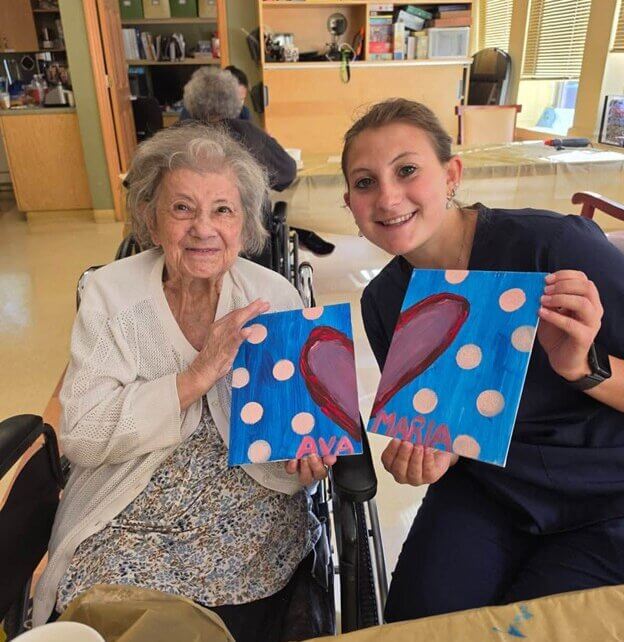
Monmouth University nursing students are participating in a new initiative that pairs them with older adults at Imperial Healthcare in Neptune, giving students an opportunity to build relationships with residents while addressing social isolation.
The program, which began this semester, gives nursing students the opportunity to spend time with residents outside a traditional clinical setting. Through weekly visits, students build relationships with older adults while helping address loneliness and social isolation.
The initiative grew out of a partnership between Family & Children Services (FCS) in Long Branch and Imperial Healthcare. FCS received a New Jersey Department of Human Services Senior Wellness Program Grant to support community outreach addressing social isolation among older adults and individuals with disabilities. FCS then contacted Cheryl Leiningen, DNP, RN, PMHNP-BC, Hess Endowed Chair in Nursing Education and associate professor at Monmouth, about involving nursing students in the effort.
Leiningen incorporated the visits into the acute care portion of a 14-week nursing course. During the first seven weeks, students focused on mental health and completed a clinical rotation at a psychiatric facility. For the second seven weeks, students visited assigned residents at Imperial Healthcare for one hour each week.
Because students did not have an in-person clinical rotation during the acute care portion of the course, Leiningen introduced the visits as an experiential learning opportunity.
The goal was to help residents develop social connections while giving students a chance to learn from older adults through conversation and shared activities.
Leiningen said she initially expected to see residents become happier and more engaged through the visits. “I thought I would really see a difference in the residents, see them be a little bit happier and more engaged, and they were,” Leiningen said.
However, she also noticed the experience was having an impact on the students. “I almost feel like it’s a ripple effect. I thought we were going to help them, but what’s happening is that it’s almost reciprocal. Who’s gaining more? I can’t even tell. Sometimes I might think it’s us,” she said.
Leah Weinreb, a BSN pre-licensure student, said the experience helped her recognize that the relationships benefited both the residents and the students.
“It taught me that everyone needs human connection. It does not matter your age, gender, abilities, etc., that everyone deserves to have friends and connection. It also made me realize that maybe I needed to meet my resident, just as much as she needed to meet me,” Weinreb said.
At first, some students felt nervous about approaching older adults and starting conversations. Leiningen developed conversation prompts to help students learn about residents’ lives, including questions about what school was like when they were growing up, how people met their significant others, their favorite singers and what they did on weekends.
Students were also asked to identify three things they had in common with their residents, something they learned, something that surprised them and one piece of advice they received.
As the visits continued, students became more comfortable and developed relationships with residents. Some looked through family photographs and listened to stories about residents’ lives, while others participated in activities such as painting nails.
During one visit, a student painted her assigned resident’s nails. The resident’s roommate then asked if she could have hers painted, bringing another person into the interaction.
Ariana Wells, a BSN pre-licensure student, said the experience showed her how even brief interactions can affect someone. “Connection is truly important and makes an impact on someone’s day, whether we realize it or not,” Wells said.
Senior nursing student Samantha Salerno said she was surprised by how much she enjoyed the experience, particularly because she had not previously considered geriatric nursing as a career interest.
“The nursing home experience was not one I would have expected to like as much as I did. I never had any interest in geriatric nursing but seeing the smiles on all of the residents faces any time we showed up made it so worthwhile,” Salerno said.
Salerno said residents were eager to talk with students, regardless of whether they were assigned to them. She particularly enjoyed visiting during the facility’s weekly happy hour, when a performer sang oldies and classics while residents played maracas and tambourines.
“I could walk up to any one of them and start dancing or singing (if I knew the words) and they would be so happy,” Salerno said.
The experience also changed how Salerno viewed the role of a nurse. Students were not permitted to practice clinical skills during their visits, allowing them to focus entirely on building relationships with residents.
“As students we were not permitted to practice any skills during our time at the rehab, so our only purpose was to sit and create relationships with these residents and I think that is incredibly important to remember going into my career,” she said. “I am so much more than just a person to give medications, I can be a support system for my patients as long as I give them the time of day to create that trusting and caring relationship.”
Cristina Kokkinakos, a BSN pre-licensure student, also said the visits reinforced the importance of addressing patients’ emotional and social needs alongside their medical care. “This experience showed me the importance of connection. It also taught me that nursing is not only about treating health problems or doing routine duties but also about supporting a person’s emotional and social well-being. My experience with my resident reminded me that even little moments matter. As I continue my nursing education, I hope to carry these lessons with me,” Kokkinakos said.
Leiningen said the initiative also gives students an opportunity to see older adults outside the hospital setting, where they may primarily encounter patients who are sick or receiving treatment.
At Imperial Healthcare, students see residents participating in activities, spending time outdoors and connecting with family members.
“Who’s filling the bird feeder? Who’s going to happy hour? Who’s sitting out in the courtyard in the sun talking to their family?” Leiningen said. “So they see a more active older adult, but maybe not someone who can be in their home.”
She said the experience can help students recognize the person beyond a patient’s age or medical needs. “It’s not just that they’re old and have nothing to offer,” Leiningen said. “This is just you, but the shell is older. Inside is still that young person.”
The initiative will continue next semester with the same group of nursing students, expanding from seven weeks to a full semester. Students will continue visiting residents for one hour each week, with visits scheduled around their existing coursework and home care visits.
Leiningen also hopes to expand the program to other academic disciplines. Occupational therapy faculty have contacted her about involving their students during the summer, and the physician assistant program has also expressed interest in connecting students with older adults.
Leiningen is also interested in exploring a future research project to examine whether the experience affects students’ empathy. One idea would involve nursing and health studies students participating in the facility visits while a sociology class serves as a control group. Students would complete surveys before and after the program to measure potential changes in empathy.
The research project is still in the planning stages and would require approval from the university’s Institutional Review Board before it could move forward.
For Leiningen, the initiative has become an opportunity for students to apply what they learn in the classroom while making a difference in the community.
“I think they’re going to see people on a deeper level and understand that even short moments of connection matter,” she said.