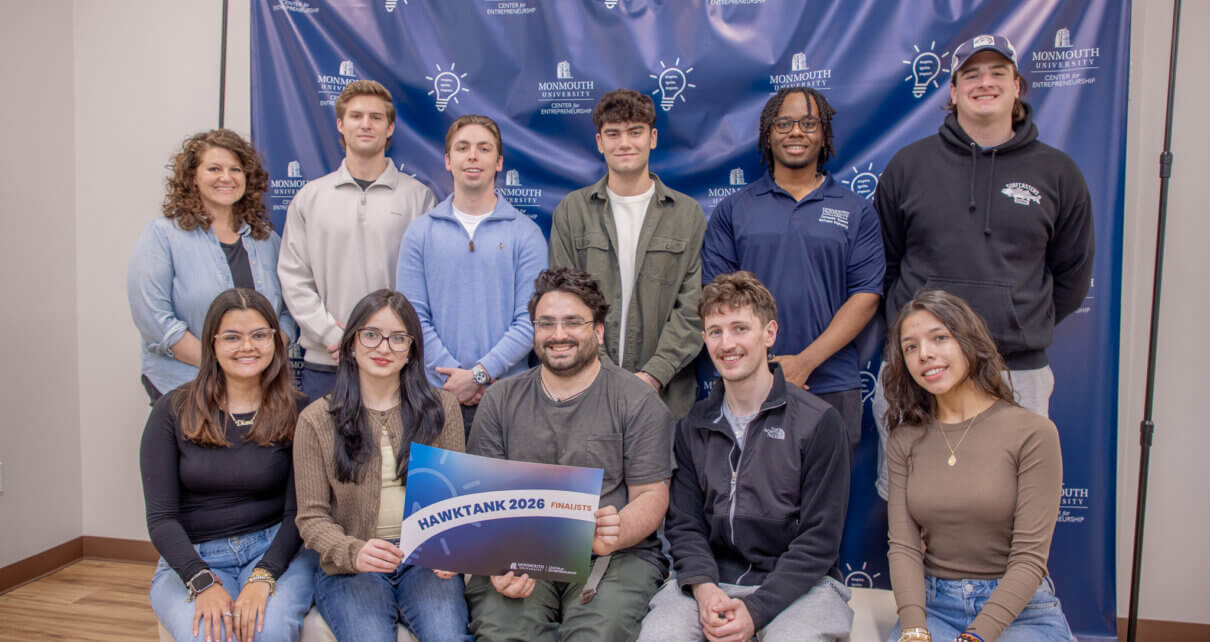
The Center for Entrepreneurship is preparing to host its annual HawkTank competition on Apr. 22, where seven student-led ventures will pitch their ideas in front of a panel of judges for a chance to secure funding and take their businesses to the next level.
From 4:30 to 6:30 p.m., Bey Hall will transform into a hub of innovation. A short reception will take place in room 127 followed by the pitches that will kick off in room 113 around 4:45 p.m.
HawkTank represents more than just a competition. For many students, it is the result of months and often years of development through the Center for Entrepreneurship. Open to both undergraduate and graduate students, the competition draws participants who have refined their ideas through programs like E-Lab, often starting as early as their freshman or sophomore year.
This year’s finalists reflect the range and ambition of projects coming out of the center. From food concepts to data-driven platforms, each team brings a unique approach to solving real-world problems.
Among them is A Grain, founded by senior Ashley Bento, a yogurt bowl concept centered around bold, signature granolas and flavor-forward combinations. Bento is looking forward to pitching her business idea publicly and getting feedback. Throughout this process, Bento has been surprised by aspects of building your own business. “Your ideas evolve a lot… it takes a lot more time to truly define what you want to sell to customers and build a business than you think,” she explained.
Pedro’s Pastelería, created by senior Diana Eleto, offers a diabetic-friendly take on culturally authentic Latino desserts, using low-glycemic ingredients to make traditional treats more accessible. She said, “Being a Hawk Tank finalist is something I’m proud of. I’ve been working on this project my entire college career and I’ve had this idea since middle school.”
She continued, “… I feel like people usually look at a bakery and think it’s easy and fun but in the way that I’m doing it there’s honestly a lot of science in math involved trying to get the ratios correct and making it as closest as possible to an original recipe that has been used for years.”
In the real estate space, DeedDrive, founded by Blake Marushak and Brandon Blythe, aims to streamline the homebuying process through a platform that tracks transactions from contract to closing.
Blythe said being selected as a finalist is a meaningful milestone as he prepares for life after graduation. “Being a HawkTank finalist is an absolute honor. As a graduating senior, I am very excited to get my professional career started. Entrepreneurship is something I have always had a passion for, so it is refreshing to have an event like this to be able to pursue a passion I have while also developing professionally.”
Other businesses focus on using technology to increase civic engagement. Pop-u-list, developed by graduate student Nicholas Carducci, uses AI to help users better understand how their views align with elected officials through a visual, data-driven system.
Before Pop-u-list became a platform, its foundation was shaped by a personal experience that influenced Carducci’s understanding of policy and finance. He said, “My interest in Pop-u-list goes back to 2008, when my family lost a real estate investment despite doing everything ‘right’ on the operational side. That experience pushed me toward economics and political science to understand how policy and financial systems shape outcomes. Over time, I realized that even experts need a better way to participate in policymaking – so, Pop-u-list is designed to help people engage with legislation directly, based on ideas rather than charisma.”
LearnAI, led by Chris Buzaid, Danny Crawford, and Kiumbura Githinji, continues to grow as a platform designed to help students and professionals build practical, real-world AI skills.
During The Outlook’s reporting on the center last month, Crawford spoke about the center’s impact on developing LearnAI. He said, “The Center for Entrepreneurship has been the catalyst for turning our initiative into a more professional venture. We evolved from just tutoring students on AI efficiency to developing a structured business model. The Center provided the professional alignment we needed to move beyond a simple idea, helping us refine our vision and navigate the complexities of customer discovery.”
OriginPay, founded by senior Viviana Ayuso, connects consumers directly with coffee growers through a direct-trade payment platform focused on transparency and fair compensation.
For Ayuso, the idea behind OriginPay is deeply personal, rooted in her connection to Colombia’s coffee culture and the farmers behind it. Ayuso explained, “The idea was born from a personal connection to Colombia’s Coffee Region. My mom is from Pereira, the capital of the Colombian coffee region, and I spent summers there growing up, visiting small farms and local shops that produced world-class coffee that most people never hear about. After touring a coffee farm and seeing firsthand the intense labor behind every harvest, I researched how little of the global coffee supply chain profits actually reach the growers — and knew I had to do something about it.”
She continued, “What started as a dream of opening a coffee shop celebrating Colombian coffee culture evolved into OriginPay, a two-sided platform that gives farmers visibility and fairer pay while also empowering coffee shops to connect directly with growers and prove to their customers that their sourcing is genuinely transparent and fair.”
Matthew Fries, a senior studying entrepreneurship and small business management and a member of the football team, founded Striper Log, helping surfcasters fish smarter with a data-drive platform that logs trips, conditions, and outcomes to surface patterns over time. Fries said, “… It combines tide, wind, water temperature, and other conditions into a visual map so fishermen can see at a glance whether their spot is going to be worth fishing, without having to check five different apps. The more users log data and use it, the smarter it gets.”
For Fries, the idea behind Striper Log started long before college, shaped by years spent outdoors. “My idea came from my deep love of fishing and the outdoors. Ever since I was a child, interacting with the natural world always brought me the most joy, and this is just an extension of that.”
Ayuso hopes the impact of OriginPay extends beyond the competition itself. She said, “It means that what started as a dream of opening a coffee shop rooted in my Colombian heritage has grown into something much bigger, a platform that could fundamentally change how coffee farmers are paid. Being a finalist gives me the opportunity to bring awareness to the people behind every cup, and knowing my family’s roots in Colombia’s Coffee Region are part of what’s driving this mission makes it that much more meaningful.”
Reflecting on the process, Blythe said one of the biggest challenges is turning an idea into something people are willing to invest in. “Something that people may not expect about building a business is that getting the idea and creating an actual prototype is the easy part. The hardest part is translating that into an actual service or product that people will pay money for. No matter what your company is, being a salesperson first is absolutely critical when getting your company name out into the market.”
One of the biggest takeaways from the program, Carducci said, has been learning how to communicate complex ideas to a broader audience. “Being a HawkTank finalist gives me the opportunity to engage directly with experienced entrepreneurs and investors as a STEM graduate student. For founders working on technical or civic problems, it’s not always easy to communicate the ‘why’ behind the product, and this program has helped me translate rigor into a clear, compelling story. It made me genuinely excited for pitch day rather than treating it like a routine update.”
As the competition approaches, HawkTank offers students the chance to take what started as an idea and present it as something real, built, tested, and ready for what comes next.
While finalists agree that putting their best foot forward with their pitch in this competition is the immediate goal, winning HawkTank would open up new doors for these entrepreneurs. Ayuso said, “Winning would help fund both the OriginPay technology and the opening of Cafeteros Coffee Shop, where I would pilot the platform with real customers and real farmer partnerships.”
“I am excited for this year’s HawkTank cohort to share what they’re building with our community,” Alison Gilbert, Director of the Center for Entrepreneurship shared. “Civic technology, fintech, real estate tech, blue tech, hospitality, AI education—the breadth and diversity of this year’s ventures reflect the cross-disciplinary, impact-driven entrepreneurship that continues to grow and expand at the Center. This year’s HawkTank group brings our total to 22 teams since we reinvigorated this program four years ago, and with each new cohort our community of CFE entrepreneurs deepens, continuing to cultivate Monmouth and the region into an emerging innovation hub,” Gilbert added.