After being recognized by the Associated Collegiate Press (ACP), in March, The Outlook has been virtually defunded by the Student Government Association (SGA).
The Outlook is the oldest co-curricular student-run organization that’s been a print publication since the inception of Monmouth College in 1933. The Outlook goes through the same annual budget request as any other student club and organization. This year the budget request that The Outlook made was the same as last year’s budget request. SGA’s decision to allocate funds that are significantly less than the request came as a shock to this newsroom. A budget cut of 41.67%, prevents the paper from printing physical copies, and drastically reduces opportunities that this club has been giving to its members, such as traveling to ACP conferences where we have repeatedly won awards, and gained national recognition for our reporting.
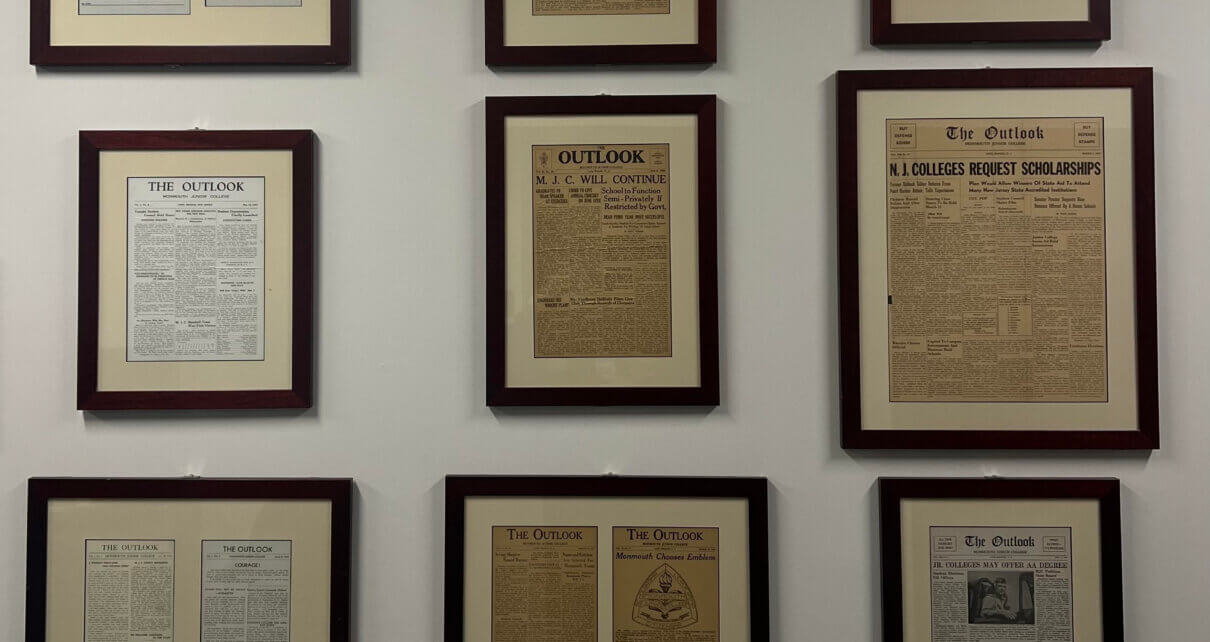
John Morano, Professor of Journalism and founder of the Monmouth University journalism program said, “Well, when one considers that The Outlook in print is the oldest, most enduring activity at Monmouth University, the first issue from Monmouth Community College opening in 1933 is hanging in the hallway outside the newsroom, and the fact that just this year the paper placed 8th in the American Collegiate Press National competition, along with the continued involvement of students from a variety of majors on campus, to then conclude that we should cut the paper’s budget by roughly 40%, the precise amount needed to produce a print version of the paper, it does cause one to wonder.”
We reached out to SGA to try to understand how this budget decision was made.
According to Brendan Sheehan, the SGA president and the former politics editor for The Outlook, this year the amount that SGA has to disperse to clubs has increased by $50, 000. He explained that the clubs and organizations requested approximately $1.2 million and SGA has half of that amount to disperse.
At the same time that SGA imposed a draconian budget on The Outlook it also raised budgets in some cases. Sheehan gave the example of the Greek Senate, which was allocated an additional $4,000 which he says was the largest increase in funding of any club or organization. Given that the budget was increased by an additional $50, 000, it is clear that there is a number of budgets that were increased even with the addition of four news clubs on campus.
When Sheehan was asked which club received the largest budget cut, he responded, “This year, the SGA experienced the largest budget cut for the 2026-2027 academic year. We cut our budget from $120,000 last year to approximately $73,000 this year, a 57% cut.” He further explained, that the $47,000 cut from SGA’s 2026/2027 budget would be dispersed among approximately 61 of the 130 clubs who applied this year. According to our calculations, a $47,000 decrease from $120,000 to $73,000 is a 39.2% cut. If this is the case, the 41.67% The Outlook budget was cut was the largest cut of any club or organization.
No attempt was made to make a contact with The Outlook to explain this drastic budget cut. Instead we received an email on April 13, with the allocated amount of $35,000. Professor Morano said, “It does seem, perhaps curious, to me that in making this monumental decision to de-fund the print edition of The Outlook, not one actual journalist on campus, myself included, received so much as a text, not to mention an email or a phone call, to discuss the implications of such an action. There was not one inquiry regarding whether there were other alternatives or approaches that might be taken. No one asked about industry or academic norms. Indeed, The Outlook is a co-curricular activity. Students can earn credit for supervised work there. There is a faculty adviser, as well. Neither the SGA nor SGA’s adviser apparently had any interest in finding out whether the de-funding would impact academic pursuits.”
In the past we’ve worked with SGA to address the printing costs. For the last two years we successfully cut printing costs by half. Our current printing costs are $42,000 annually. SGA was aware of that as we explained it during the budget carousel. We wondered how SGA came to the decision to cut our budget so drastically given that the move would certainly prevent us from printing the paper as we have done so for nearly 100 years. We put this same question to Sheehan, “Unfortunately, fewer students are picking up physical copies of The Outlook at the stands across campus. The result of this is large quantities of copies being disposed of at the end of every week. As we evaluate how we can make the best use of every student dollar, we took into consideration the volume of newspapers being disposed of every week and found it unsustainable. We are not advocating for nor forcing The Outlook to stop printing or transition entirely online, nor is this an attempt to prevent publication. This is an economic choice in a national environment that is transitioning away from large quantities of print newspapers to less print copies and more online publications,” he said.
Professor Morano explained that the idea of an online version “seamlessly” replacing the print version is inaccurate. “Of course, both are available to the university community, but as far as the paper can tell, the level of engagement with the print version far exceeds what they find from the digital version.” He continued, “Not everyone has reliable internet or phone service. Not everyone is willing to search and click several times just to get the paper. Many people forget that the digital paper has been issued because it can be ‘out of sight, out of mind.’ That same issue on a newsstand can be quite engaging. There’s a reason why The New York Times, The Washington Post, The Wall Street Journal, The New York Daily News and so many others that could easily go fully digital, don’t.”
A study by the American Press Institute found that 74% of 16-to-40-year-olds get news and information at least weekly from traditional news sources, including print newspapers, according to ACS Media Group. While print media has traditionally been linked to older audiences, trends indicate a shift in its audience, according to a 2024 Media Max Network article titled, “Why Newspapers and Magazines Still Matter.” In an era of digital misinformation Millennials and Gen Z are turning to print media for credible, well-researched content, the article explains. The article also points out that print media often serves as a “cultural connector” for Black, Hispanic, and LGBT communities. “They offer a platform for voices and stories that may be underrepresented or overlooked in mainstream digital media.”
In a “Dear Editor” letter from Monmouth University Latin American Student Organization (LASO) they shared the same sentiment, “The Outlook plays an essential role in making that possible. It provides a platform where diverse voices, including those from underrepresented communities. Where many can share their stories, raise concerns, and celebrate their identities in a meaningful and visible way.”
“I do believe that print publications are important,” Richard Veit, PhD, Provost and Senior Vice President for Academic Affairs said. “For nearly a century, The Outlook has done great work reporting about what is happening on campus. I understand that the SGA was unable to fund the budget at its previous level. I look forward to working with colleagues from Student Life, Academic Affairs, and the SGA as we work to support The Outlook in an environment with limited budgets,” he said. While the administration is citing limited budgets, it is easy to observe that Monmouth University prints various publications in full color. For example, we notice Monmouth Magazine which also has an online version laying around campus and offices and is made available to the campus community in print form. We point that out only because it shows inconsistency in how the cost of printing a student newspaper is framed by the SGA President, Sheehan, as an “economic choice.” In addition, SGA advisor Dr. Vaughn Clay said about his role in this decision, “My role is not to make unilateral decisions when it comes to the annual funding of clubs and organizations, but rather to participate in a broad, collaborative process with SGA leadership. Budget decisions are made through multiple layers of discussion and evaluation, taking into account institutional perspectives, feedback-metrics from clubs and organizations who are applying, as well as any financial considerations that may arise from one year to the next.”
According to a Columbia Journalism Review from December 2016, the experiment with online only publications is showing to be a failure. They write, “The reality is this: No app, no streamlined website, no ‘vertical integration,’ no social network, no algorithm, no Apple, no Apple Newsstand, no paywall, no soft paywall, no targeted ad, no mobile first strategy has come close to matching the success of print in revenue or readership.”
Regardless of the assertion that The Outlook’s physical copies are left on the stand at the end of the week, this is no evidence that the paper is not reaching the readership. Columbia Journalism Review cites studies that have found that print editions “reach 28 percent of circulation while digital versions reach just 10 percent.” The Outlook is well within these trends if not better in terms of circulation. Additionally, Pew Research Center collected data on time that digital readers spend on news sites, and it is less than five minutes.
Eliminating print publications can have a chilling effect on the campus community. It’s a known act of silencing that universities have used in the past. According to Indiana Citizen, In October of 2025, Indiana University announced it was suspending print editions of the Indiana Daily Student citing a budget deficit. A 158 year old newspaper was forced to go digital-only but the move caused a widespread outcry and the University reversed its decision. According to Professor Morano, “…the elimination of a print version would remove the paper from newsstands across campus, in effect, silencing headlines that some on occasion might find inconvenient, truthful and accurate, but inconvenient. It’s not a stretch to wonder if the action is a form of censorship.” According to NPR, as a fallout, Indiana University also faced a lawsuit from a former advisor to the paper who was fired after he, “stood up against the censorship.”
Other universities in the country are attempting to limit student journalism by limiting access to newsstands. According to The Christian Science Monitor from March 21, 2026, University of Texas at Dallas limits the number of newsstands on campus making student press more difficult to access. As The Christian Science Monitor explains, “The controversy in Dallas is one example of mounting challenges student journalists face nationwide, from censorship to administrative stonewalling to the elimination of print editions.”
Professor Deanna Shoemaker, Chair of the Department of Communication shared her concerns with SGA’s decision to defund The Outlook. “In a moment when we need independent journalism, a free and open press, and critical thinking more than ever, it is deeply troubling that our award-winning and longstanding Outlook newspaper is in danger of losing almost half of its funding for next year. This means that our 93-year old student-run newspaper wouldn’t appear in hard copy anymore. I wonder what our distinguished journalism alumnus, Linda Deutsch, would say, after she gave a substantial gift to annually support outstanding journalism students at Monmouth, if she was alive today? If you walk the second-floor halls in Plangere, you’ll see framed historic Outlook stories from the 1930s all the way to Anti-Apartheid protests, Martin Luther King, Jr’s visit to campus in 1966, Sit-Ins, the 9/11 attack, Hurricane Sandy, and more. I urge all faculty, students, and staff to pick up an Outlook newspaper each week to explore the important stories that hold our campus accountable, celebrate our exciting work at MU, and help our students engage with the world. Having the Outlook appear only online does NOT serve our students or our community well, and I hope our campus will help us fight back. I want to thank the generations of ambitious and courageous students who have spent many hours working to print our weekly campus newspaper, which is vital to our democracy,” she said.
The Outlook has been a historical record of the life of this University. A few semesters ago we assisted Springsteen Center’s archivist, Melissa Ziobro on her project, offering old print copies of the paper for her research. It is in moments like this that one fully appreciates the importance of print in the world in which we are subjected to the content often hidden behind the screens and online paywalls. As Monmouth Review’s Editor-in-Chief Zafira Demiri aptly put it, “Although online forms of publication are great they are ephemeral…how can we trust that our voices will be heard if there is no physical proof of it?…How do we know that we–the students–are even here?”
In addition, The Outlook has a strong academic and professional component. It serves as the ground for academic instruction and for training future journalists in their own profession. Print journalism skills are as relevant as ever. Professor Morano explained, “On an academic note, I have never seen a student walk into my class waving their phone around, excited that their story made page one. I have seen many students walk into News Writing class with print paper in hand opened to page one, smiling broadly, proudly.”
He continued, “Also, academically and professionally, the design of a print page is quite different from the design of a digital page. It is a skill that students should learn and practice. The Outlook is the best, perhaps only, opportunity at the University for them to do that. At least, it was until SGA decided to de-fund the opportunity.”
Dean of the School of Humanities and Social Sciences, Dr. David Golland described The Outlook as a, “high quality, longstanding student newspaper,” and added, “The Outlook should be doing hard-hitting stories that challenge authority as part of its mission to teach young journalists to become professional journalists.”
The Outlook is appealing this decision. “I have heard that the paper can appeal the decision, as if that will impact it. But whom do they appeal to? My understanding is that they appeal to the same people who made the decision. One would think that a less involved third party might be more likely to recognize if there was any irregularity, bias or other agenda in this action. It does seem that appealing to the people who decided this, is more of a formality than an actual appeal. I hope I’m mistaken, but there’s not a lot about this decision and the process that causes me to think otherwise, sadly. It is frustrating to see people who have no degree or professional experience in the field making decisions as if they know something that those who actually practice and study journalism don’t know, unless of course, you don’t want to hear what experts might say,” said Professor Morano.
As to what the legacy of this important student paper is and for those who wonder why the printing should continue, one has to just walk into the Plangere Center and look around. “If anyone in the Monmouth University community is unsure what the print edition of The Outlook means to the institution, I would encourage them to take a stroll to the second floor of the Plangere Center and see just a few of the classic front pages hanging on the walls. In fact, the building that houses this display was in large measure paid for by a journalist who admired The Outlook, Jules Plangere. He also wrote the check that paid for the display of the front pages. And, at the end of the hallway is a sign above the newsroom that says, The Linda Deutsch Center for Student Journalism, another donor who was an editor at The Outlook when she attended Monmouth College. There’s over $8 million in donations to the University from just these two people, both directly associated with The Outlook, but it seems SGA and their adviser can’t fund a print version that has been funded for over 90 years previously and is regularly recognized nationally. It is a curious and sad decision, to say the least,” Professor Morano concluded.