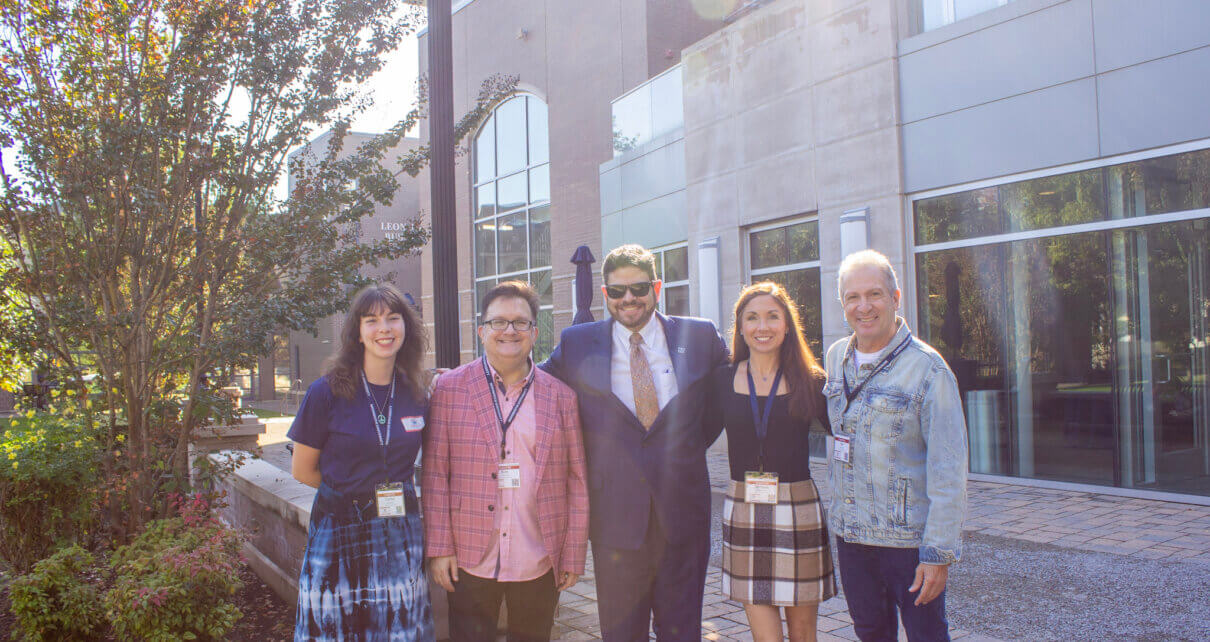
Monmouth University brought together more than 70 scholars, writers, educators, musicians, and other experts for a three-day academic conference examining the role of music in American history and cultural identity.
The Bruce Springsteen Center for American Music and the Wayne D. McMurray School of Humanities and Social Sciences hosted “Music America: The Sounds and Songs That Shaped Us” Oct. 16-18. The conference featured close to 40 sessions covering genres and artists ranging from classic rock and hip-hop to disco and symphonic music.
Melissa Kozlowski, curator of the Bruce Springsteen Center for American Music, said organizers wanted to bring together people who approach music from different academic and professional perspectives. “A lot of work went into creating a program that showed just how many different ways music can help us understand the American experience,” Kozlowski said.
The conference continued the center’s exploration of the United States’ 250th anniversary, an initiative that began in 2024 with the launch of the traveling exhibition “Music America: Iconic Objects from America’s Music History.” The center has since expanded the initiative through programming, concerts, and publications.
Presentations examined music in relation to race, class, war, protest, literature, law, education, and regional identity. Artists discussed included Louis Armstrong, Woody Guthrie, Bruce Springsteen, Beyoncé, and Taylor Swift.
Ashley Kahn, a two-time Grammy-winning American music historian, author, professor, and producer, spoke during a plenary session titled “Paul Simon and Graceland.” Holly George-Warren, a two-time Grammy-nominated author and music historian, also presented at the conference, discussing how John Steinbeck’s The Grapes of Wrath inspired generations of songwriters.
David Golland, dean and professor of history in the Wayne D. McMurray School of Humanities and Social Sciences, presented research on the Santana Blues Band and its significance during a period of racial integration in American music and society.
Another presentation examined Springsteen’s song “The Ghost of Tom Joad” and its connection to the character of the same name in John Steinbeck’s novel “The Grapes of Wrath.” The discussion explored class and labor in American history through the song’s literary connections.
Golland also moderated a plenary session on Paul Simon’s album “Graceland,” released in 1986 during South Africa’s apartheid era. The discussion considered how artists approach protest and dissent, including their use to challenge oppression and the questions that can arise from artists’ own decisions.
“These are meaningful questions still today as we consider the role of music and other forms of art in the desire to improve the world and the human condition,” Golland said.
Kenneth Womack, professor of English and popular music at Monmouth, participated in a session titled “Rave On! Buddy Holly as Songwriting Juggernaut” alongside guitarist Sam Popkin. The session explored Holly’s life and musical contributions before his death in 1959.
Womack said the conference gave historians an opportunity to share research on the relationship between music and national identity. “The Music America conference established a forum for historians to share new insights about the ways in which music has shaped and reshaped our nation’s identity,” Womack explained.
He also praised the university’s role in bringing scholars together to examine music’s place in American culture. Womack said, “I am really proud of our team here at Monmouth University for hosting this event and challenging scholars to think deeply about the music that exists at the cultural core of American history.”
Kozlowski said one of the conference’s highlights was the range of discussions, particularly the opportunity to bring traditional academic scholarship together with public history, museums, exhibitions, and education.
The conference also reflected the Springsteen Center’s work beyond the musician’s own career. Although Springsteen remains central to the center’s programming, Kozlowski said its mission includes examining the broader history of American music through scholarship, education, and public discussion.
“I hope attendees came away thinking about American music not simply as entertainment, but as an incredibly rich lens through which we can explore our history, culture, and identity,” Kozlowski said.
The conference also generated a small financial surplus after expenses. Golland said the funds will support student programs throughout the School of Humanities and Social Sciences, including the undergraduate Psychology conference, Debate Hawks, Model United Nations, and the Mock Trial Team.
Golland said the event helped strengthen the relationship between the school and the Springsteen Center while creating opportunities for Monmouth faculty and students to present research to an academic audience. He also identified increased academic visibility for the university as a goal of hosting the conference.
For Kozlowski, the conference demonstrated how the center can connect its exhibitions and concerts with academic research and the university community. “A conference like this allows us to bring all of those things together and, importantly, to connect the Center with the academic life of Monmouth University,” Kozlowski said.