
Have you noticed that sports fans have seemed nastier and nastier recently? Have you noticed that every game you go to has fans fighting and screaming at players, and that social media is full of avid fans threatening violence on players after the final score is announced? Offensive signs are brought to games, fans get into players’ faces, and more and more items are being banned from games because of violence.
Sports has become a place of shame instead of celebration, and it’s starting to affect more than just a few teams at a time. Gone are the days of having just a divisional rival you and your friends poked fun at. Now, the stakes have grown so high that these rivalries and controversies are sparking hands-on violence and threats both among players and fans.
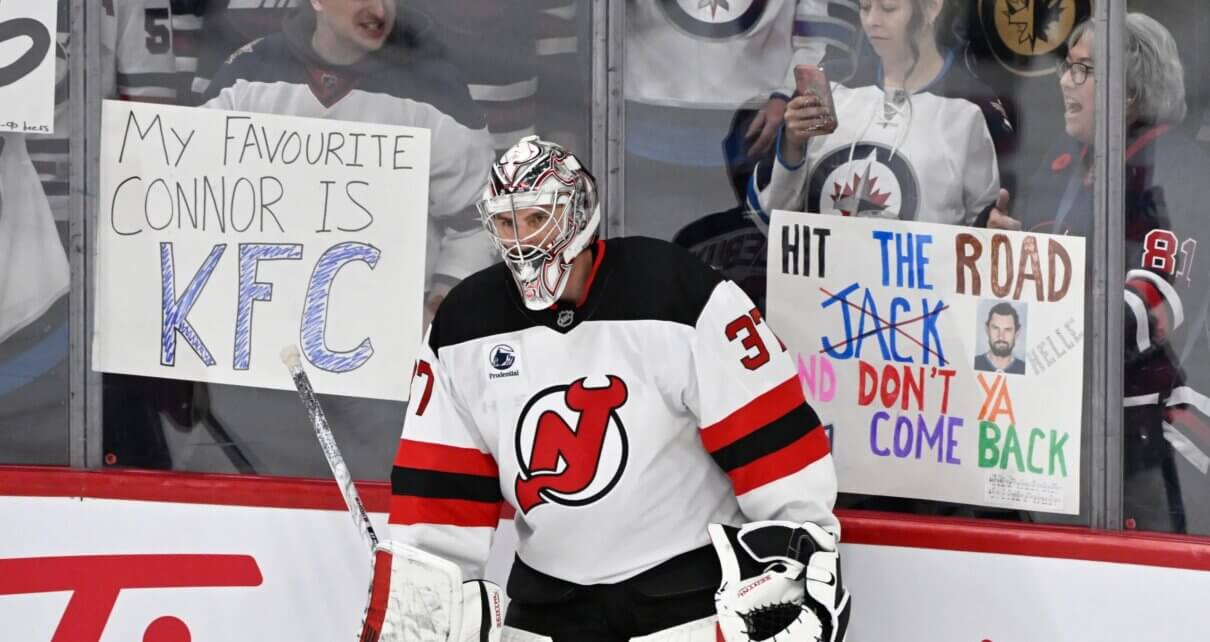
If you’re a fan of the NHL, you are probably aware of the trade that recently happened between the Winnipeg Jets and the New Jersey Devils around Connor Hellebuyck. What you may not be aware of, though, is what happened the first time the Devils played the Jets after the trade. When Hellebuyck first took the ice in Winnipeg on Nov. 10, Jets fans filled the arena with boos, screaming “where is Connor?” and “pull your goalie,” and brought signs with malicious slogans targeting Hellebuyck.
The violence didn’t stop when the clock hit zero, though. According to Devils announcer Don La Greca in an interview on Don, Hahn, and Rosenberg, Jets fans followed the Devils to their hotel after the game, asking if the hotel they were arriving at was Hellebuyck’s, and the police eventually had to get involved in dispersing the angry crowd of Jets fans. Helleybuyck also addressed threats made to him and his family while in Winnipeg in a press conference after the game, which were “more than online death threats.” Keep in mind that Helleybuyck did not play in the game against the Jets, but did state in the press conference that he had wanted to.
These actions aren’t exclusive to hockey, though. On Nov. 8, ABC 7 reported that multiple fights broke out inside and outside of a San Francisco 49ers and Las Vegas Raiders game, resulting in 11 arrests and 45 ejections from the stadium. Multiple videos circulated online of people being knocked unconscious in the parking lot and huge brawls breaking out in the stands.
Another similar incident occurred on Nov. 15 at a San Francisco 49ers and Dallas Cowboys game. Multiple fights broke out amongst Cowboys and 49ers fans inside and outside of the stadium, with multiple of these fights having to be broken up by law enforcement.
The internet is also a hotspot for cyberbullying of teams and players, especially on X. As recent as this week, the internet has been full of death threats, serious or not, against Pittsburgh Steelers wide receiver DK Metcalf after their loss to the Cincinnati Bengals on Sunday night. One X user posted “DK metcalf meet and greet” with a short video of bodycam footage of a victim being shot repeatedly by police. Whether this was intentionally harmful or thought of as funny by the fan, this could be seen as an extreme threat against Metcalf, his team, and his family.
This behavior is even seen at school sporting events, including ours. Earlier this year, Erik Pratt, a basketball player from Stony Brook University, was ejected from a CAA conference game after spitting on a Monmouth University fan who was sitting courtside in the student section. While Monmouth went on to win the game, the event was a huge controversy on campus and led to Pratt being suspended from the CAA for Stony Brook’s next game.
Abby Kosch, a junior communications major said that she has witnessed Monmouth fans acting unsportsmanlike against players. “I know it happens at many schools across the country, so I don’t think its an isolated issue at Monmouth” said Kosch, “but I would agree by saying our fans can get rowdy at times, especially at basketball games when they’re given access to the courts.” Fans seem to be more rowdy when they are given closer access to the players, as their words have more velocity up close rather than on social media or from far up in the stands.
Frank Horale, sports editor, also added that he notices an uptick in “rowdy fans,” as many tailgate before kickoff, making their emotions run higher.
Our students have also noticed increased cyberbullying when it comes to our student athletes at Monmouth. “I’ve also seen after some sporting events on campus, students running to social media apps to blame our athletes and borderline bullying them,” Kosch said.
Juliana Marcello, a junior marine and environment biology and policy major, added, “I definitely see a problem on social media, especially after a loss.”
On YikYak, an anonymous campus-wide social media app, fans always make fun of our players while asking them to throw parties, bullying them if they don’t succeed and celebrate with the students. They will even target students off the field, pointing them out just because they are a college athlete. One anonymous user posted, “MONMOUTH FOOTBALL FRESHMAN YOU ARE IN TROUBLE! YALL ARE P***** FOR STEALING A TABLE FROM FEMALES”. If this had happened with a group of students who were not college athletes, there probably would not have been a post about it, but because the students involved were football players, they get blasted schoolwide on YikYak.
While a lot of this activity boils down to rivalries, a lot of it has to do with the psychology of the fans. A study published by the Arizona State University Center for Problem-Orienting Policing stated that fighting at stadium sporting events is more likely when teams have dedicated fanbases, when a particularly important victory or loss happens, and when division rivals face each other. For example, as stated before, the 49ers and Raiders are conference rivals due to their close proximity.
Another factor is linked to alcohol availability and consumption. At professional games, alcohol is available for purchase to fans 21 years old and over, and at professional and college games, many fans tailgate and drink before entering the stadium. ASU states in their study, “While drinking does not ‘drive’ people to act violently, alcohol can impair the judgment of people who are predisposed to violent behavior. Excessive drinking can cause people to act overconfidently and carelessly, lose awareness of their surroundings, and react violently to people they perceive as offensive.”
While fighting is never a welcome thing at sporting events, it is becoming more and more common in the stadium, outside of it, and online. Even at our school, bullying on and off the court happens more often than you think, and it’s due to a multitude of factors. While many may not realize that what they are doing is bullying and harassment, it is. If you ever notice something like this at a game, just know that it’s more common than you think. By not engaging in the activity, you’re helping it become less common. So, grab a staff member, move somewhere safer, and help make games safer for fans everywhere.

