
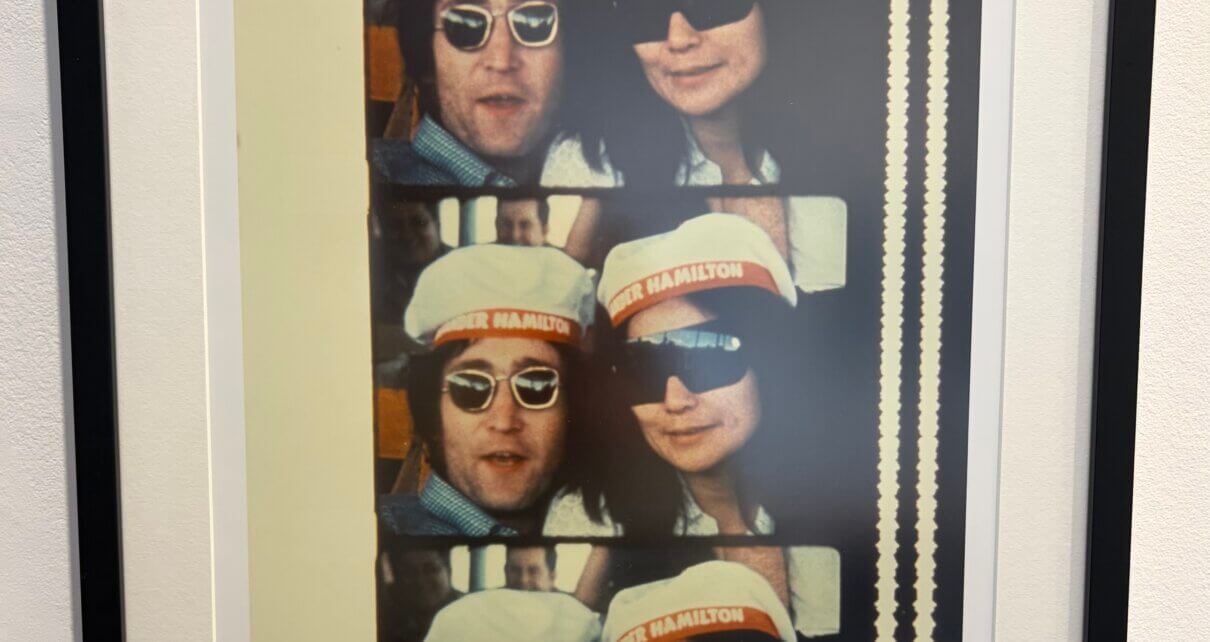
Right behind Rechnitz Hall, you’ll find the Ice House, which is home to a collection of limited-edition photographic prints, film stills, and archivals dedicated entirely to Jonas Mekas’s work. The exhibition, open to all Monday-Friday until Dec. 15, offers a glimpse into the moments, big and small, that Mekas captured on camera.
From the Kennedy’s, Yoko Ono and John Lennon, Elvis Presley, and the World Trade Center, to the more ordinary like nature, being human, and celebrating life, Jonas Mekas completely transformed what it meant to curate art. Because of his style, he is considered to be one of the leading figures of American avant-garde filmmaking, and his films have been screened at festivals and museums around the world.
Born in 1922 in Semeniskiai, Lithuania, he emigrated to the U.S. with his brother in 1949 and eventually settled in New York. An unknowing perspective allowed him to approach new surroundings with a sense of wonder.
The content he produced in pursuit of understanding this unfamiliarity was the same content that would go on to win awards like The Lithuanian National Award (1995), The New York Film Critics Circle Award (1996), and International Documentary Film Association Award, Los Angeles (1997), according to the university’s Department of Art & Design.
But what truly distinguishes Jonas Mekas from other filmmakers isn’t necessarily the people he captured or the recognition he received, but rather the way in which he chose to take in the world around him.
According to Corey Dzenko, a professor for the Department of Art and Design, Mekas challenged traditional approaches to filmmaking by turning his camera towards the people, places, and experiences closest to him.
“His images were like snapshots of every day at a time when showing the personal was still experimental. He would store his personal archive, and one of his approaches to editing would be to pull random things from the archival shelf, cut them together, and then make sense of them,” said Dzenko.
A particularly good example of this is Jonas Mekas’s film Lost, Lost, Lost (1976), which features material from his arrival in New York that sat unused for years. What began as a documentation of immigrant life transformed into a reflective piece on displacement, memory, and identity.
That same film immortalized little details like dancing and singing and neighborhood streets and storefronts, as well as peace demonstrations and anti-nuclear protests. Much of his identity is rooted in the “ordinary” moments, so those moments naturally became subjects worthy of preservation.
Dzenko explained that Mekas’s work carries mult
iple layers of meaning, allowing audiences to connect with moments that might otherwise seem insignificant.
“Mekas’ films and visual work embody common experiences that are relatable to people. It gives those relationships and moments a weight or importance,” said Dzenko.
She further elaborated by saying, “I teach my students that art has layers of meaning. Regarding Mekas, this means that when he presents his images and films as art, they take on additional meaning from fleeting moments. They are not merely documentary records of his experiences. Rather, his audience can relate to and interpret the fragments that Mekas presents edited together.”
Perhaps one of the most interesting aspects of Jonas Mekas’ artwork is how relevant it remains to this day, especially in an age where documenting everyday life comes as second nature. From Instagram posts to short-form videos on TikTok, this generation has developed its own way of preserving personal histories.
“Studying the past helps us better understand the present. You can draw a direct link between experiments by Mekas and others using the personal archive to today’s selfies culture. I’m not equating them, but there are parallels to consider about sharing our private lives publicly,” said Dzenko.
Decades later, the human experience remains remarkably familiar.
“This is not something that has been done across time and cultures. Doing so depends on cultural practices. It also depends on the various technologies we develop and use–film for Mekas and social media for many of us,” Dzenko concluded.
So while technology might be different, both methods raise interesting questions about what we choose to preserve, what we choose to share, and how those moments shape the way others understand us.
As a photo historian, Dzenko drew a connection to Nan Goldin, who, similar to Mekas, worked with intimacy and snapshot photographs. She explained that there isn’t a universe in which there is no manipulation by the observer or the artist. The difference for Mekas is that he grants us access to the more intimate moments.
Goldin first showed her work through slideshows set with music. She chose to photograph her “chosen family.”
“The instance of photographing, instead of creating distance, is a moment of clarity and emotional connection for me. There is a popular notion that the photographer is by nature a voyeur, the last one to be invited to the party. But I’m not crashing; this is my party. This is my family, my history,” Goldin wrote in her photography book, The Ballad of Sexual Dependency.
For a generation that has grown accustomed to documenting nearly every aspect of daily life, Mekas’ work offers insight into the history and meaning behind that instinct. For the Monmouth community, this exhibit reminds us that capturing a moment is only the beginning. What we choose to preserve and the meaning behind the memories is what makes them lasting.
After all, as Mekas’ work suggests, sometimes the most extraordinary stories are found in the most ordinary moments.


